Tuesday, June 26, 2007

Cornish Parish Register Online Project


Grandson outgrows bucket!

The Cornish Parish Register Online Project (C-PROP) is a daughter project of the Cornish Online Parish Clerk (OPC) scheme. The project aims to transcribe all the Cornish parish register entries and place them online, free-to-view, in a searchable database. The project encompasses other sorts of data such as the West Briton lists of “hatches, matches and dispatches”.

The people involved are Myra Cordrey (OPC scheme co-ordinator), Diane Donohue & Julia Mosman (LDS liaison), Bill O’Reilly (COCP “fixer” & C-PROP uploader), and myself, recruiter for C-PROP. I am also the Free Census organiser for Cornwall and the other four are all OPC for various Cornish parishes.

A current project is to re-type the contents of the well-known Phillimore marriage lists. Done at the end of the 19th century, these are a valuable transcript of the parish registers. Often the work was carried out by vicars with the co-operation of the parish priest. These people were experienced with the records and of course, the records were younger than they are now.

Although this data is a typed transcript, we need it re-typed into our standard spreadsheet as a vital intermediate step to uploading into the database. We would like to capture all the information in the lists. You are invited to place the additional information in the two notes columns that are provided.

You will see that there are a lot of columns you won’t need. This is because the spreadsheet was designed to cover all types of registration document and the later registers carried a lot more information.

Each parish should have its own spreadsheet and on completion, each parish should be emailed to me. Do not wait till you have completed the volume. I will eye-ball it and then forward it to one of the two uploaders. They will check it more thoroughly for layout and other problems and upload it to C-PROP.

When you have graduated from the Phillimore project we hope that you are sufficiently enthused to volunteer to take on some actual parish registers. These are supplied on disc and involve transcription as well as data input.

C-PROP can be seen on http://www.cornwall-opc-database.org/ Check out the coverage table to see your name in lights! Currently, we have well over half a million records online. With your help we should hit a million soon. Well – quite soon.

Monday, May 21, 2007

NWOCP Newsletter No 8


Minack cliff-top theatre in Cornwall


Centre of picture - girl with smile - yet another grandchild!


The NWOCP continues to make steady progress with the 1841 returns with about half of them now transcribed and online. However, movement on the 1861 & 71 is much slower and on the 1891 there isn't anything to report.

What I would like you to do if you are working on the 1861 or 1871 returns is to drop me a line sometime. Please confirm the details below and give me a rough estimate of your progress. Transcribers can just tell me which image they are on and how many they have left; Checkers can select review progress under Options and just cut and paste the results into their email.

Some of you have not written to me for a long while and I really need to have some idea of how you are doing - or if, indeed, you are doing anything. I received a disc the other day from a chap who had it for a year. He had never written to me and had not made a start on the piece.

This is an option open to everyone. If you don't want to carry out the task, then just let me know and return the disc - no hard feelings on my part.

If you are finding it hard work, please take my advice and just do a few hours a week; it will get done sooner than you think.

Email is very simple - so just please write to me!!!!!

1861:

1269 Highworth being transcribed by Liz Price
1270 Swindon being transcribed by Helen Ward
1271 Swindon being checked by Phil Pike
1274 Cricklade being transcribed by Peter Collins
1278 Malmesbury West being checked by Allan Kennaird
1280 Castle Combe being transcribed by Marlene Bond
1281 Corsham being transcribed by Chris Hughes
1284 Chippenham being transcribed by Kevin Lacey
1286 Calne being transcribed by Peter Reddick
1288 Marlborough being checked by Ray Smith

1871:

1884 Wootten Bassett being transcribed by Lianne McDowell
1890 Malmesbury East being transcribed by Kren Hayes
1891 Malmesbury West being transcribed by Amanda Coles
1892 Malmesbury West being checked by Keith Salisbury
1894 Castle Combe being transcribed by Paul Webb
1895 Castle Combe being transcribed by Harry Tadd
1896 Corsham being checked by Heather Williams
1898 Chippenham being transcribed by Nancy Frey
1900 Christian Malford being checked by Valerie Henwood
1906 Marlborough being checked by Edmund Bristow

Friday, April 27, 2007

COCP Newletter No 21 - 1881 project

Hello folks


Recent family history lunch in Cornwall.

At the moment there are twelve people checking 1881 returns; some of whom are waiting for their first zip. This is a revisit to blog newsletter of March 10th this year.

This transcription was given to us and is not in the FC format. It has to be reformatted before it will go into the FC checking software. The transcription is a good one and most of the problems in checking stem from the reformatting that has had to be done.

Schedule numbers and page breaks are inserted arbitrarily during reformatting because there are none in the transcription. The reformatting will only input page breaks with a household start. Often, where a page break comes in the middle of a schedule (on the image), the change is not being noted by the project checkers. Checkers must check the header detail for every household and keep an eye open for changes during a schedule.

There is also a problem with lodgers. Enumerators should have treated them as a separate household. Sometimes they did and sometimes they didn't. Even where the enumerator got it right, the non-FC transcribers frequently ignored the separation of landlord's family and any lodger. If a lodger has a schedule number of his own; he is a separate household. If he does not, he is part of the relevant household.

The transcription does not include the uninhabited dwellings and public buildings. Free Census requires they be inserted. This involves inserting a new record. The header detail of this new record will reflect the previous household unless the checker changes it.

The occupational field in the donated transcription is more generous than FC allows. During reformatting the occupational data is often split and part of it is dumped in the notes field. Checkers cannot edit the transcriber notes field, but they can tidy up the occupational field. By the use of judicious abbreviations you can get the information into the limited space available. If you are uncertain of what is allowed, browse the existing returns on our web site. Our aim should be to produce something that is correct, makes sense - and looks nice!

The original transcribers seem to have entered all "unmarried" people as "single". I do not want all the "S" changed to "U" but they also seemed to have classified everyone 14 and above as "S". If there is nothing in the marital status column on the actual returns, then pse change it to a hyphen.

It might seem a bit perverse to do the 1881, given that the Mormon version has been available for so long. Please be assured that we are finding errors and correcting them, so it will be worthwhile. And will lead to us accomplishing our task - to transcribe ALL the Cornish 19th century returns and make them available free-to-view.

Sunday, April 15, 2007

COCP Newletter No 20


Hello folks

My garden last summer; this year summer is coming early! The cat is sunbathing (he has to have sun block on his remaining ear); the Starlings are back in the roof and the weeds are growing fast. I should be concentrating on the garden; but there are all these census returns........

We continue to upload returns from 1851, 71 & 81. We are now down to 10 1851 parishes or bits of parishes. Another couple of months should see it finished. At the moment Kay & I are chasing up 1871 volunteers to see what they are doing. Or not doing.

If you are in the habit of writing to places such as the Rootsweb mailing lists; can I ask you to use a signature block advertising that you are a volunteer for COCP? The publicity helps me.......

Email must be the easiest form of communication invented (maybe texting is more so). Would anyone like my mobile number? And we also have jabber........ But still, many of you don't seem to appreciate how easy it is to drop me a line to tell me how you are getting on. Or even to tell me you are still alive! Strangely enough, I have had five volunteers die whilst on the job and their next-of-keen were quick to look through their emails and contact me to tell me the sad news. It is the living ones who are not playing the game fairly.

If you don't want to carry on - just let me know and send the disc back.

The parish register project has now broken through the half a million barrier. Next stop one million!

I am offline April 17-24th inclusive. That means there is still 48 hours for you to drop me a line and to enlighten me as to what you are doing. Or not doing.

Rgds and good luck!

NWOCP Newsletter No 7


Hello folks

Six frightening years I spent down the back of this!

The project continues to upload lots of 1841 stuff; rather less 1861/71/91 stuff. No 1891 returns as a matter of fact have been uploaded for some time. Does anyone have a microfiche reader?

If you are in the habit of writing to places such as the Rootsweb mailing lists; can I ask you to use a signature block advertising that you are a volunteer for NWOCP? The publicity helps me.......

Our web site owner has now got a roll of honour - take a look to see if you are there. He would like to post pictures on it. I would like you to as well - it would be nice to see what we all look like!

Email must be the easiest form of communication invented (maybe texting is more so). Would anyone like my mobile number? And we also have jabber........

But still, many of you don't seem to appreciate how easy it is to drop me a line to tell me how you are getting on. Or even to tell me you are still alive! Strangely enough, I have had five volunteers die whilst on the job and their next-of-keen were quick to look through their emails and contact me to tell me the sad news. It is the living ones who are not playing the game fairly.

If you don't want to carry on - just let me know and send the disc back.

I am offline April 17-24th inclusive. That means there is still 48 hours for you to drop me a line and to enlighten me as to what you are doing. Or not doing.

Rgds and good luck!

Michael

Wednesday, March 28, 2007

NWOCP Newsletter No 6


Hello Folks

Two more grandchildren, but this time there is a connection. The grand daughter is actually the youngest transcriber I have ever recruited! Her mother says that it will keep her away from The Sims! We will see......

In the last month we have uploaded:

1841
HO107/1164 Hundred of Alderbury. Pat Mahoney (Aus)
HO107/1180 Hundred of Kinwardstone. Peter Eastman (UK)
HO107/1185 Hundred of Selkey. Carol Patios (Aus)

[All 1841 checking done by our web site host, John Pope (UK)]

1861
RG101277 Malmesbury. Sue Flower(UK) & Phil Pike (UK)

1871
RG101882 Swindon. Jane Brown (Can) & Phil Drew (Aus)
RG101886 Sue Flower (UK) & Ray Smith (UK)

Four people have dropped out and two more have joined. I am still worried by lack of contact with a number of you. If you haven't written to me in the last two months, please drop me a line. If you are not actually going to do what you have volunteered to do, please post the disc back to me.

At the last Free Census rebuild we had contributed 95,922 records - good going for 14 months. This includes five of the 1841 Hundreds. Of course, the NWOCP web site contains a lot of 1841 records that have yet to be uploaded to Free Census.

Don't forget - please drop me a line!

Wednesday, March 14, 2007

How quiet it was!

Taken in 1904.

The other day I was sat at the top of my long narrow garden, drinking coffee & smoking a small cigar. I suddenly noticed that I could hear the cries of three buzzards soaring above the village. Young buzzards often stay with their parents for a couple of years, so I expect this was a family group.

I live in a very small Cornish village called Mitchell. First mentioned in a court case in London in 1235, it used to be called Medeschole. The court case confirmed the landowner’s charter to hold an annual market here. Medeschole was an artificial borough created to sit on a cross roads. In the 13th century many such boroughs were created in England and the English parts of France. Our cottage is in the middle of a terrace of granite houses built about 1850 for workers in the giant lead mine at Wheal Rose, about a mile north of the village.

Behind the cottages are long narrow gardens, about 20 feet wide and 120 feet long. Typical working class gardens they would have had a flower area, a rather larger area for vegetables, a few fruit trees and possibly, a sitting out area with a patch of grass. At the top of the garden is a stone privy complete with thunderbox. A long walk on a winter night.

What has this got to do with buzzards? Well, the A30 lies a few hundred yards north of us and in the garden there is a constant background noise from the traffic. It never ends and usually you just ignore it. I could hear the buzzards because there was a break in the traffic. It set me to thinking about how quiet it must have been here when Medeschole was young.

There was a chapel here and although it fell down about 400 years ago, it is known it had a bell. So that would have tolled at set times. The nearest church is over two miles north, so you wouldn’t have heard that very often. There was a blacksmith at the other end of the village, so you might hear the banging and clanging from there.

There would have been some noise from the Stanna Way, which ran through the village. There would almost certainly have been a few drinking establishments. Just to the west of Mitchell is a very large hill and no doubt the carters etc would have needed a drink after the descent and one before tackling the hill if going westwards.

Overall, it would have been very quiet, above all because there would have been very few people. An estimated 25,000 in the whole of Cornwall in 1086 and 35,000 in 1377. Current population is approaching half a million!

Nothing but the cries of the buzzards

Monday, March 12, 2007

Yet another rant from Cornwall

Democracy in Cornwall

Who are the voters in Cornwall? First of all, there are the Cornish, people born here of parents born here of parents born here…….. There was a debate in the local press at the time of the last census in 2001 and a well-known protagonist of “Cornishness” ended up saying that if you lived here and felt Cornish – you were Cornish.

Only about half the electorate are Cornish (however you define it); the other half are like me – blow-ins as some rude lady once said. However, many of us have lived here for a long time, and unlike many of the Cornish, we have chosen to live here. So, I will call us the Cornwallians.

As we all have a single vote, any major change should aim to carry us all with it. Which is where what I call the “Western Ghettoists” go wrong. They want enforced Cornishness and they also want the rest of the UK to pay for it. A very unlikely arrangement!

At the moment in Cornwall, we have seven layers of government. At the top is the French government in Brussels. Unelected by us and remote and untouchable. And unloved. Below them comes the Scottish government in London. Roughly speaking most of us don’t like them at all. Below them is a regional assembly. Unelected and situated in Swindon or somewhere up there. Nothing to do with us and also disliked.

Finally, we reach Cornwall. Sitting in Truro is the County Council, overall rulers of the county. Heavily constrained by the three layers above them and increasingly secretive. We get to vote on them every 4 years, but we always return the same people. Odd that, as no one has much time for them.

Below them are the six District Councils. These are the nuts-and-bolts people. They collect the rubbish, maintain the street lights and so on. We get to vote for them, but don’t care much for them. Most people think they cost too much.

Right at the bottom are the Parish Councils. Also elected, they have few powers but they usually have to be consulted and they are required to consult us – the voters – and we are right at the bottom.

How does all this work? Well, in my small village (now 150 households), a developer wants to build a row of five houses. At the village consultation no one was in favour. The Parish council advised against. The District Council voted it down and it went to appeal. An unelected bureaucrat in Bristol, who probably doesn’t even know where we are, has approved the plan. Democracy it is not!

Now, the Scottish government is thinking about yet another re-organisation of local government. The paranoid section of the press thinks this is all part of a secret plan by the French government in Brussels. But it is probably just something governments do when they are desperate to do something. They have called for helpful suggestions.

The County Council wants to abolish the District Councils. The District Councils want to abolish the County Council. They both claim their plan will save money. We know it won’t. But it doesn’t matter what we want – because we are not being asked. The County Council has conducted a telephone poll of 1000 people and says they like its plan. Really? Who are these people? Are they all council taxpayers?

What this shows is that democracy in Cornwall is in short supply. The voters are irrelevant to these people. I don’t have any solutions – well, I do – but they won’t be adopted.

As a last resort, perhaps taking one in ten of them out and shooting them might help!

Nothing to do with census returns!!!!


This lady is a distant Aunt of mine called Catherine Delaney.

From the census returns, I knew that a great great grandmother of mine was born in Gibraltar. She stuck out like a sore thumb in the returns for Birmingham. I viewed the parish registers for the main (and only?) RC church in Gibraltar for a likely period - and there she was. Shout of joy that caused the customers of the Mormons in Helston to gather round. Some kind lady in Cheltenham translated the abbreviated priestly Latin for me and I discovered that her father was a corporal in the 94th Regt of Foot. I also found she had a brother.

I found a lot of information on the IGI - but it was placed there by a member of the Church and there didn't seem to be any way of contacting him or her.

My next step was to pay a researcher to look for Cornelius Delaney in the army records at Kew. Two lots of £25 bought me a great deal of information about him. A search of the Army records also turned up another 4 children, all born to another wife.

Catherine Delaney was born about 1835 on a ship off Malta. Her father's regiment had moved from Gibraltar to Malta and was now on its way to India. He didn't spend much time there and was back in Ireland by 1836. He managed to fit t being busted from Sgt to Private for being drunk on bathing parade!

I posted my Delaney details on the Delaney message board and much to my surprise got responses from two ladies in Australia. It seemed I had lots of relatives out there! The whole family had gone to Tasmania on a convict ship, the SS Rodney. Cornelius was an Enrolled Pensioner Guard. Catherine married a convict (or ex-convict) in 1851 and soon after that, the whole lot of them moved to Victoria. She died in 1913 and this photograph is said to have been taken shortly before her death.

One of the Australian respondents on the Delaney message board put me in touch with the Mormon source. She was an 82-year old lady living in Sidney. She had a computer but didn't use the internet. We exchanged information and we both ended up with much better family trees. She had been studying Cornelius and his family for 60 years! By the way, this made me look at the IGI in a different light.

What a life Catherine had! Three long sea voyages when they were very unhealthy. I don't suppose that Tasmania was very safe in 185o either. Yet she lasted 78 years! They made them differently in those days!

I sometimes look at her picture and wonder what she would think of me.......

A final note is that Cornelius is another of my Irish brick walls. Although I know where he was born and when, he isn't on the parish register. Lots of Delaneys, but not mine.

Saturday, March 10, 2007

COCP Newletter No 19

Hello folks

This week we have completed 7 more 1871 pieces plus 3 1881. They should all be online soon. The number of 1851 parishes being worked on has fallen to about a dozen. Shouldn't be long now. The February rebuild of Free Census showed that we have completed and uploaded 1,500,741 returns.

At the moment there are ten people checking 1881 returns and it is this project that is the subject of this newsletter. This transcription was given to us and is not in the FC format. It has to be reformatted before it will go into the FC checking software. The transcription is a good one and most of the problems in checking stem from the reformatting that has had to be done.

Schedule numbers and page breaks are inserted arbitrarily because there are none in the transcription. Often, where a page break comes in the middle of a schedule, the change is not being noted. Checkers must check the header detail for every household and keep an eye open for changes during a schedule. There is also a problem with lodgers. Enumerators should have treated them as a separate household. Sometimes they did and sometimes they didn't. Even where the enumerator got it right, the non-FC transcribers frequently ignored the separation of landlord's family and any lodger.

The transcription does not include the uninhabited dwellings and public buildings. Free Census requires they be inserted. This involves inserting a new record. The header detail of this new record will reflect the previous household unless the checker changes it. Ths comment also applies to volunteers checking the other years.

The occupational field in the donated transcription is more generous than FC allows. During reformatting the occupational data is often split and part of it is dumped in the notes field. Checkers cannot edit the transcriber notes field, but they can tidy up the occupational field. By the use of judicious abbreviations you can get the information into the limited space available. If you are uncertain of what is allowed, browse the existing returns on our web site. Our aim should be to produce something that is correct, makes sense - and looks nice!

We have now completed the 41, 61 & 91 returns; the 51 is almost complete and about 60% of the 1871 is done. More & more work is going to be 1881. I have just spent 3 days validating a single 1881 piece!

Finally, a reminder that we are transcribing "as is". It doesn't matter if the Enumerator is wrong - we want to record his words. Place names, surnames, relationships - it doesn't matter - get down what he wrote. Leave notes if it will help. If I don't think researchers will understand our finished work, I will write a note for them.

All in all, things are going well. Another couple of years and I can retire and grow cabbages. Or something.

Saturday, February 24, 2007

COCP Newsletter No 18


Hello from Cornwall. As usual, the picture has nothing to do with anything. It shows me and five grandchildren on my birthday last year.

Although things might seem very quiet, we have been getting on with the project. Since the beginning of the year we have uploaded:

1851
West Looe Joan Oliver & Frances Kenshole
Redruth Asylum Joan Oliver & Frances Kenshole
Saltash (completion piece) Moira Hurst & Ken Hosking

1861
1579 (completion piece) Shirley Franklin & Maxine Cadzow
1584 (last piece) Carrol Parfait, Maxine Cadzow & Marion Paul

1871
2224 St Stephen John Warren & Julia Mays
2257 Newlyn East Faye Ammermann & Jan Lewis
2318 Redruth Caroline Buckland & Ken Hosking
2338 Penzance Paul Archie Courtney-Williams, Frances Kenshole & Carrol Parfait

1881
2297 St Columb David Trounce
2303 St Austell David Trounce
2321 Wendron Althea Johnson
2323 Wendron Althea Johnson
2324 St Keverne Althea Johnson
2325 St Keverne Althea Johnson
2326 Breage Althea Johnson


In the pipeline are 7 1871 pieces and half a dozen 1881. Redruth 1851 was a very large piece - over 10,000 records - and puts the 1851 within a couple of percent of completion.

Free Census rebuilt its database on the 21st February and we have now contributed 1.5 million records - some 16% of the total.

The online parish register project continues to grow - nearly 480,000 records online. It is now possible to upload all or some of the details from post-1837 marriage certificates using an online submission form. Forms for births & deaths will follow. A number of volunteers are busy inputting the Phillimore marriage lists and extraction of hatches, matches & dispatches from the West Briton transcription project continues apace.


Sunday, February 04, 2007

NWOCP Newsletter No 5

This is aimed at the 1841 volunteers, but it is mostly valid for any year.

When a parish spreadsheet comes in, I reformat it as .csv and load it into FCTools. The diagnostic package details the errors & warnings. Errors have to be fixed, but warnings may not be serious enough to do anything about. But I usually do them with the 1841 parishes as they are so small. I then marry them to a data file and produce a zipped file for checking. I load this into the checking software to see it loads OK and then send it off to the checker.

There is only one checker for the 1841 - our web site host - John Pope. He produces a checked zip, often accompanied by colourful comments, and sends it to me.

I load this into Valdrev and validate it. The output zip from Valdrev then goes back into FCTools for a final burst of corrections. The refined output zip is sent to John, who turns it into html and uploads it to his web site.

When a whole Hundred is done (we have done two so far), I run all the validated zips back through FCTools to produce a series of spreadsheets. I stitch these all together and run the resulting giant spreadsheet back through FCTools to produce a final validated file. This goes back to John for him to create the html. Once I have looked at that and re-assured myself that all looks well, I send the data zip off to a guy name Bill O'Reilly. Amongst other things, he looks after the upload to Free Census side of things for me. You need to be a Windows user to do that and I am not one of those.

Common errors. I am not saying that you all make them or that anyone makes them all - but they come up again and again.

1. Do not use question marks or any other such characters anywhere except in the notes Col Y.

2. Make sure that all households have a schedule number - zero. Make sure that all uninhabited dwellings & public buildings have their own record complete with sched zero.

3. No entry must be on more than one line. If you cannot abbreviate an address for instance onto one line, then put some of it in the notes column.

4. Stick to the plan on folio numbers. Pages without a number take that of the preceding page.

5. If you are uncertain of anything - flag it up.

6. Addresses must only be entered against a schedule. They must not appear in the middle of a household. If a household straddles a page break; backtrack to the previous page and enter the address there.

7. Col T - county of birth - must have a 3-digit code from the table in the Free Census Field descriptions.

8. There is no need to use capitals or put the "y" after ages. You must put "m, w or d" if they are applicable though.

9. All records must be transcribed, including those crossed out.

Don't forget to keep an eye on the blog on http://medeschole.blogspot.com/

Saturday, January 20, 2007

A Gigantic Whinge

The aim of Free Census is to provide an accurate transcription of the pages of the Enumerators' books. To that end we transcribe "as is". This is the so-called Golden Rule of Free Census. Just by chance the other day, I noticed a little girl called Olive E Smith, born in Lydiard Tregoze. But the Enumerator had written Oliff E Smith born Liddiard Tregooze. That is what the transcriber should have written.

When I start new checkers off, I always state what seems obvious to me. Checkers must try and identify AND then fix the transcriber's errors. In the case of Oliff, the checker detected the error and left me a note. This is NOT correct practice. The checking software allows you to do many things and all but one field can be corrected. Only the transcriber's notes cannot be edited by a checker.

My final whinge for today concerns communication. Emails must be one of the easiest and fastest systems of global communication yet invented. Why then, do I not get regular emails from volunteers? All you have to do is drop me an email every month or couple of months telling me what you are doing. It would be nice if you had a subject line - NWOCP 1287 would tell me at once what you are working on. For transcribers, just say your piece has 253 images and you are working on image 157. For checkers it can be more accurate. Under Options you can select review progress. This tells you exactly how many records you have, how many you have done and how many are left. You just cut and paste this into your email.

Finally, if you don't want to do what you have volunteered to do - then please, oh please, tell me. There will be no hard feelings. Although the task is quite easy to carry out, it can be a pain. Lots of people drop out - for all sorts of reasons. Just let me know and return the disc.

Tuesday, January 02, 2007

Occasional rant by Blog owner!

My wife and I have a newspaper each every morning, which we read over breakfast. Most mornings produce a rant from Michael, which she endures politely. I have decided to have an occasional rant on my blog. If you don’t want to read it, don’t. If you wish to comment, be my guest.

A sneaky announcement on December 29th (after the New Year holiday had started) revealed that the EU had wimpishly given in to the demands of the US government over transatlantic flight passenger information. Well, I say announcement, but in fact it was only revealed after a Freedom of Information release, forced by the Tories.

Under this deal, airlines will provide the US Government with 34 pieces of information on people flying into the USA. This information will include name & home address; email address, telephone number and credit card details. This last will not only show which card has been used, but will allow the US government to access the credit card account.

Although the justification for this invasion of privacy is anti-terrorism, the US Government reserves the right to look for other sorts of alleged violations of US law. Not EU law or British law – US law. Some two dozen US agencies will have access to this data and the US Government reserves the right to share information with “foreign” governments.

In my opinion the EU should immediately insist on reciprocity. Every US citizen flying into the EU should have to provide the same 34 bits of information. Plus they should have their fingerprints taken, pictures taken and be finally and ritually humiliated by having to provide a DNA sample. The EU should also insist on a visa, although we will waive that under a visa-waiver scheme. Sound familiar?

However, the EU is pretty gutless at the best of times and the UK no longer has the power to go its own way. But just in case any US readers think their privacy is safe, their government is going to “encourage” US airlines flying into the EU to provide the information anyway.

I have spent many happy times in the USA. I did a rough count the other day; since 1958 I have made over 50 visits to that great country. I don’t think I will be visiting again. Shame

COCP Newsletter No 17

Hello from Cornwall

Here in the southwest of the UK, the day has started off dark, wet & windy. Just like yesterday really. What a difference a new year does make!

Anyway, I hope that you all had a lovely Christmas and wish you all a happy & prosperous New Year.

The world's largest project of its kind (COCP that is) has trundled along during 2006, just like it has during the previous five years. We have just one piece of the 1861 left to do and that is with a checker right now. The 1871 is about 60% done and the 1881 is edging up to 20%. The spotlight of my attention has shifted to the 1851 (sounds a bit naff that). There are 20 parishes or bits of parishes left to do. Most are pretty small and I am hoping that all those working on the 1851 will crack on.

At the beginning of 2006 we had 1,117,534 records uploaded to Free Census - at the end of the year we had 1,454,770. Quite an achievement; my thanks to everyone.

On the wider front, Free Census now has just under 9 million records online with the COCP contributing 16%. A third English county (Wiltshire) has uploaded its first 1841 piece. The Cornish parish register project (C-PROP) has gone through the 460,000 record mark.

NWOCP Newsletter No 4

I hope that you all had a lovely Christmas and wish you all a happy & prosperous New Year.

The world's largest project of its kind (Free Census that is) has trundled along during 2006, just like it has during the previous five years. Our project has done rather better than most of the other English projects. At the beginning of 2006 we had 15,000 records uploaded to Free Census - at the end we have 73,000+!!!! Quite an achievement; my thanks to everyone.

Of course, we have rather more than that on our own web site. Last month we uploaded the first 1841 Hundred. There are only three English 1841 projects and the other two are complete. 1841 parishes are rolling in on a daily basis; I hope that everyone working on the 1861 & 1871 is encouraged by this and will be cracking on!

Our web site is also carrying some returns from outside Nth Wilts as Terry clears his backlog.

Cornish 1851 Project update


Hello folks

Another grandson - the only one bearing my surname!

Here is the status of the 1851 project. If your name is on here and it shouldn't be, please let me know. If it should be on and isn't - let me known. If you are doing a piece that isn't listed here - let me know.

Trying to be realalistic, this looks about 3 months work to me. Be nice to be proved wrong again!

Virginstow Ho5a1896 Being transcribed by Sandra Coles

St Giles OTH Ho5b1896 Being transcribed by Julia Bassett

Lanteglos by Camelford HO5h1898 Being transcribed by Trudi Groves.

Maker HO5a1900 Being transcribed by Gillian Johnson.

Rame Ho5b1900 being checked by Ken Hosking

Menheniot Ho5a1902. Being checked by Arthur Hodge

St Cleer Ho5b1902 Being transcribed by Bill Phillips

St Neot Ho5d1902 Being transcribed by Ainslie Jones

Duloe Ho5b1903 Being transcribed by Caroline Buckland

Morval Ho5c1903 Being transcribed by Nick Russell

East Looe Ho5m1903 Being transcribed by Mike Beck.

West Looe Ho5n1903 being transcribed by Joan Oliver

St Blazey Ho5d1906 Being checked by Maxine Cadzow

St Stephen in B Ho5e1908 Being checked by Frances Kenshole

St Mewan Ho5f1908 Being checked by Mark Jose.

St Stithians Ho5a1914 Being transcribed by Luke Harris.

Gwennap Ho5b1914 Being transcribed by Lauren Patey.

Redruth Ho5a1915 Being checked by Peter Veryan; Di Thompson; John Nance

Gwinear Ho5b1916 Being checked by Jean Minter.

Friday, December 08, 2006

The Cornish 1841 census

In the West Briton in late May 1841, a series of articles appeared entitled "Hints respecting the new census, to be taken on Monday 7th June" The writer is not identified but the way it is phrased suggests he is not a member of the authorities. I have only quoted parts of it on the grounds of size.

1. The best mode of taking a census is by a map and a register. On the map, the situation of houses only should be marked. Every house should be numbered, and then a register of every inmate made. The commissioners have adopted the plan of a register, and arranged an expensive machinery for taking it, but the form is very imperfect. It is to be written in pencil. Ages above 15 are to be entered thus - at 29, put 25, if 34, put 30, and soon. If a person has two Christian names, only one is to be inserted. The county where born is to be recorded, but not the parish, which the Act also requires. Such a register will be of little use. At the same cost one might be taken which would ensure an accurate census, and might be useful for many purposes in a parish till the decennial enumeration of 1851. A register of this kind was prepared in 1831 for a large parish in this county, and has been of great service ever since.

8. Instructions to the registrars and Enumerators have been issued by the commissioners, together with the householder's schedule. A copy of the latter is to be left at every dwelling the week before the 7th of June. 3,600,000 copies of it have been printed. The enumerators will do well, though they have the choice of employing an agent, to distribute these schedules themselves, as they will thereby become better acquainted with the extent and condition of their respective districts.

9. No instructions have as yet been given in the Superintendent Registrars, to whom the schedules and register books are to be finally brought. There appears, however, to be no intention of forming a summary of them for each parish and union before they are transmitted to London. Persons interested in the statistics of the county should bear this in mind, and endeavour to secure a summary for the use of the public in Cornwall before the documents are all sent away. It may be that otherwise they will have to wait a twelvemonth before the results are made known. [from here, the print becomes distorted]

10. It is very desirable that each Enumerator should provide for himself a map of his own district. This cannot be a [choice]... [article then continued that circles should be drawn, and numbered to indicate 1 house with 7 persons, or 56 houses with 268 persons, maintaining the system would then include all dwellings, not just those in towns and villages.]

16. A circular has been addressed by the commissioners to the clergy, requesting their co-operation in taking the census. Though it comes late, it will, no doubt, meet with due attention. A short note on the subject appeared in the last Ecclesiastical Gazette, and from the extensive circulation of that paper many may be lead thereby to examine the plan proposed, and to aid it by their advice and direction. No time should be lost; the business should be undertaken at once, during the next week, through the medium of committees, or by giving personal assistance to the enumerators.

19. On Monday next, the 7th of June, an attempt will again be made to form a Speculum Britannice, or mirror of the inhabitants as to their condition and locality, when they arise from their slumbers on the morning of that day, to give an exact picture of the then living generation, and to perpetuate a description of it for present and future use. This will be found no easy task - it will require all the assistance which the appointed officers, the local societies, the clergy, and others can give to render it complete as a national work. The institutions at Falmouth, Truro, Tavistock, Plymouth, and elsewhere should be on the alert. A statistical view of eight miles round St. Andrew's church, Plymouth, showing, inter alia, how the population is located, as well on the water as on the land, would be a valuable present to the British Association on their meeting at that beautiful harbour in August.

20. The enumerators will do well to keep for their own use and future reference a correct copy of their register, which they need not deliver over for a week, till Monday the 14th of June. Attention should be paid to the queries at the end of the registers whilst they perambulate their districts, as it may otherwise be found difficult on their return to prepare answers to them. The clergy are to transmit the abstracts of burials from 1831 to 1840, from the parish registers to the Bishop, on Monday, 21st of June. It is recommended to preserve in each parish a summary of the return.

Wednesday, December 06, 2006

Transcribing for Free Census


The problems encountered by transcribers can be divided roughly into two groups. Those concerned with the mechanics of FC transcribing; layout etc. And those concerned with making sense of what is written down by the enumerators.

One of the easiest ways of dealing with the mechanics of the task, is to sit back at the end of each page and each ED and look at what you have done. Most of the fields have defaults. In some cases, fields can be blank as a default, but many must have something in them. The county of birth column for instance, Col T, must have a 3-digit code from the Chapman code entered. You cannot leave it blank. Well, you can, but it will then surface as a mistake when I reformat it for checking. If you take a long slow look at each page, you should be able to see where things are missing.

My own personal preference is to transcribe vertically. I do the personal names first, then the surnames, then work to the right, always going down the page. Finally I fill in those details required to the left of the surname. I flag things up as I go if I am uncertain; I also change the text colour to red. If I leave notes, I try to write the sort of thing I write when validating. I have mixed feelings about autofill; but I am a touch typist which makes it easy to type, rather than clicking on the autofill selection. You have to watch the autofill, checkers have complained that people are selecting it without checking it is what they really want.

There is little to be done about the enumerator's writing except hope that you will get better at reading it; or you'll reach the end of the ED and the next one will be better. You can try and improve the image by manipulating it with IrfanView or Photoshop. However, you can also edit what you have done and the fact that personal and place names are often repeated might give you a chance to take a second look at what you have done.

One thing everyone should do is ask themselves - is what I have transcribed sensible? Recently I had a piece where the address was transcribed as "1uoodfbock". Not once, but three times. The transcriber flagged it up. In fact, it was "Woodstock". How many words are there that end in "ood"? Not many.

There are also things you can use to help you sort problems out. The first is Google. Both place & personal names may be detected by Google. Then there are the census returns on line. In Cornwall, most parishes now have 4 sets of census returns online and Wiltshire will slowly build up to at least three sets per parish. There are online gazetteers and sites that list old occupations. However, if you can read what is written, then don't waste time, just type it in. I don't mind you leaving me a note and in some cases it might make it onto the database.

I can see from the notes that many people are worried by the relationships given. Sons that look as though they should be grandsons. However, that is not our problem. Our task is to get down what is written, not correct it. By the way, "son in law" had a rather different meaning in the 19th century. It might have been more correct to say "son by law", and we would say stepson.

One trap that is very easy to fall in to, is to correct the enumerator's words. We are committed to reproducing the exact words the enumerator used. If he is wrong - tough! We have a golden rule "AS IS". If you stick to that, you can't be wrong.

Remember that this is a system. Transcriber, checker, validator and post validator. Transcribers should try and combine speed with accuracy. Don't spend hours over one word; give it your best shot and move on, flagging it up if you are unhappy.

Good luck!

Thursday, November 16, 2006

This week in Cornwall

Here in Cornwall, we are always looking for new ways of doing things. We are also very conscious of the past - we are sort of moving forward into the past.

Until about 1850, there was a treadmill in Bodmin Gaol; there were other gaols in the county that also had them. Criminals would be sent there for a few weeks to while away their days turning a treadmill. Usually, this was for minor offences such as being drunk and disorderly. This was in the days of course, when you could be hung for stealing a sheep, or even worse, sent to Australia!

We have just as much disorderly behavour on our streets now as we did then, perhaps more. In 1850 there were very few people from England taking their holidays here. If any.

So, the authorities have decided to re-introduce the treadmill. It has two main advantages as a punishment. It is cheap. Criminals will live at home; have to make their own way to the treadmill and bring their own food and drink. The treadmills will be linked to banks of batteries that will provide power for the lights and for boiling the kettle for the supervisors.

In the 19th century, the treadmills were used to grind flour and this week a deal has been struck with a well known organic biscuit maker. His name is a commercial secret but think feathers..... Just imagine, not only organic, but hand-ground flour. Well, foot-ground anyway.

Of course, there might be people who get in the wheel and refuse to walk. A small amount of electrical power will get the wheel moving, when it will become very uncomfortable to refuse to walk.

In fact, I say walk, but many people will be running. The person who completes the most miles in each day will get one day knocked off their sentence! Of course, there will some sort of handicapping system so that little old men will have a chance.

The first bank of wheels will be in a well known seaside resort and it is hoped that the building will incorporate a viewing gallery, entry to which will incur a small charge.

Saturday, November 11, 2006

NWOCP Newsletter No 3

Hello Folks

I have been a little remiss with these newsletters just lately. Partly summer visitors, partly computer problems (self inflicted) and partly biting off more than I could chew.

However, things are rolling along and we have recruited several new people, including one this morning. Some people have completed their task and left; others have dropped out for various reasons.

1861. We have 22 pieces to do; 4 are online; 2 are being checked; another 4 are waiting for a checker to appear and the rest are with transcribers.

1871. 32 pieces to do; 6 online; 7 being checked; another 5 transcribed and waiting for a checker; the rest are all with transcribers.

1841. 12 Hundreds to do. All are being worked on and 5 have some parishes complete and online. The 1841 is being done and uploaded by parish. One Hundred is nearly finished, when I shall stitch the parishes together and upload it to Free Census.

1891. 4 pieces online; one being transcribed. There is another piece partly transcribed. The transcribers for this were an Australian couple who have worked for me on the Warwickshire project for six years. Dick was diagnosed with cancer and died in less than two months. A real blow to me, even though I had never met him.

Don't forget to visit my blog on http://medeschole.blogspot.com/ now and again. Although it is called Cornish Census Returns, much of it is equally applicable to our project. This will be posted on it this morning.

And of course, you could check out our own web site - have a gloat!

I would like to take this opportunity to thank you all for your support. Keep them coming!

Rgds

Michael
Organiser, Nth Wilts Online Census Project
http://www.pope-genealogy.me.uk/nwocp.htm

Sunday, November 05, 2006

British early census returns

The arrangements for the taking of a decennial census were set out in a Parliamentary act in 1800, but there had been discussions on the necessity of taking a census for many years. At the time of the first census, in 1801, the country was at war. We had had several bad harvests and maritime conditions were unstable. Many of the agricultural workers were in the Army or at sea. The government needed to find out how many people lived in Britain, what they were doing and where they were doing it.

The first census consisted of six questions. The first 3 were to be answered by house-to-house enquiry on 10 March 1801, or as soon as possible after that date. These questions established how many dwellings, how many people and what occupations they had.

The next two questions were addressed to the local clergy asking how many baptisms, burials & marriages had taken place. These covered the period back to 1700 in the case of baptisms and burials and back to 1754 for marriages.

The final question just asked if there was anything else the respondents would like to say.

The government sent out printed forms and the whole exercise was supervised by the Overseers of the Poor or “other substantial householders”.

The results consisted of numerical totals and did not include names. However, some local returns still survive giving names. The returns were affirmed before local Justices of the Peace by a certain date. They then went up the chain to the Home Office in London. The answers given by the clergy followed a different route and ended up with the Privy Council.

In 1811, the census asked the same questions, but with knobs on. It distinguished between uninhabited & building dwellings. The question about occupation was also amended. The clergy were asked to record the numbers of baptisms, marriages and burials registered in each of the ten years since the last census.

In 1821, additional questions were asked about the ages of the people. These were grouped in five year bands up to 20 & in 10 year bands after that.

In 1831 more extensive questions about occupations were asked. There were seven categories. Agricultural, manufacturing, retail or handicraft, capitalists, mines & fishermen, retired or disabled and finally, those employed as servants.

In addition, the clergy were asked to indicate the number of illegitimate children born in 1830.

In 1841 changes were made that are, in essence, still with us today. The returns included, for the first time, the names of the respondents. The carrying out of the census was handed over to the General Registration Office and the census was organised on tbe basis of the new poor law administrative districts.

The story of the British censuse is one of gradual change. It is also a story of a struggle between those who wanted to keep it simple (Home Office, GRO etc) and those who wanted to ask as many questions as possible. These latter including various scientific and social institutions as well as government departments. This struggle continues, as could be seen in the UK press last week.

Wednesday, November 01, 2006

Free Census checking software

Yet another volunteer checker struggling to get the checking software to work! We have repeatedly asked Free Census to sort it out but its like talking to a rather dim brick wall.

Here is a simplified way to do it:

Download WINCC

Save to desktop

Double click on icon

Unzip into c:\wincc. This folder will be the one suggested by WINCC. Say yes to creating a shortcut, it will take you to Windows Explorer. Drag the shortcut icon to your desktop.

Open WINCC & follow the instructions. Enter personal details - 4-digit code, first two letters of surname & first two letters of forename.

WINCC will then want to test the external drive. Normally it would expect to use the A drive, the floppy drive. If you don't have one, but you do have other removable media drives, WINCC will say it has detected more than one removable drive. Removable in the sense that you can put media in yourself.

Select one of these, but you must have something in the drive. Perhaps the best option is to plug your digital camera in and try selecting that drive. You must restart WINCC after plugging the camera in.

If you don't have any removable drives, then WINCC will just ignore the test requirement.

Once WINCC has a drive, it will create a small TEST directory. You can open this and play with it.

When you open WINCC you get the first record overlaid with the first household panel. You must tab through all fields on this household panel to get to the first record. You must check as you tab on both types of record. The second field is Ecclesiastical parish. If there isn't one, then enter a hyphen.

Don't spend a lot of time with the TEST directory, import the data zip under Options and try it out. You can import from the floppy drive A, or there is a folder in WINCC called ZIP. Copy the still zipped data file to that folder and import from there.

Remember that you can re-install WINCC and re-import the data file if things go wrong.

Pay particular attention to the BROWSE button; it will allow you to insert records, split households ect. Right clicking on the BROWSE screen brings up help.

Saturday, October 21, 2006

This week in Cornwall

Quite an exciting week in Cornwall!

On Thursday there was an earthquake roughly along the valley of the river Tamar. Cornwall is now an island! Associated with this on Thursday evening, a tidal wave swept in at Hayle – and West Penwith is also an island.

Temporary bridges will be placed over the Tamar chasm at the main former crossing points. There will a toll on traffic entering Cornwall with the money being used to reduce Council Taxes. Council Tax payers will be exempt from these charges. The King Harry ferry will serve West Penwith till we can afford a bridge.

A new swinging tax on holiday homes will be introduced next Wednesday. The money raised this way will be used to reduce Council Taxes.

The NHS institutions in Cornwall are to be controlled by a new governing body. Membership will be restricted to Council Tax payers and they will be elected by Council Tax payers.

Institutions of Higher Learning in Cornwall will be grouped together, although on dispersed sites, and will become the University of Cornwall. The Universities of Exeter & Plymouth will be told to mind their own business.

In future, anybody living full time in Cornwall and paying Council Tax will be entitled to claim they are Cornish. The rest will be known as “the English”.

Anybody suggesting that road signs etc should be bi-lingual will be asked to sign a legally binding form that commits them to paying for the changes.

The new French toxic waste plant will be moved to England. We shall use our rubbish to enlarge the Scillies.

Wednesday, October 18, 2006

COCP Newsletter No 16

Hello folks

Sun is out in Cornwall; off up the garden for a cup of coffee and a cigar. Might even do some gardening.

If you imagine the COCP as an inverted triangle, we have transcribers at the top, forming the base, then checkers in the middle, then, right at the bottom, me. All pieces are validated by me. I like it this way, although it means a lot of work, because it gives me control of the project and allows the imposition of a certain style. If something is wrong, I can ensure that it's like that on all the returns - wrong that is!

There are two aspects to the errors I see. Firstly, there are some rather depressing repetitious ones. Irish county Chapman codes for instance. Secondly, there is the sheer ingenuity displayed by many volunteers, in inventing new problems. Congratulations!

I am just doing a Truro piece. There is a Mr James who is a Coal Merchant. Next door is another Mr James. This gentleman is a Cod Merchant. It certainly looks like Cod, but neither the transcriber or checker have flagged it up, so presumably they thought that in 19th century Truro it would be likely there was a Cod Merchant. Seems a bit specialised to me, so I changed it to Coal. In fact, the letter "d" often looks like "ol" or "al".

I might be wrong of course; if anyone knows of other Cod Merchants, let me know.

What other things have attracted my attention? If you want to put RN in the occupation field, please put a space between the R & the N, otherwise you'll upset the Fishheads by getting Rn.

Don't put in unnecessary notes. If you are unsure of a surname, a note on the head's record is good enough. I have to delete or edit all these notes.

Don't put in unnecessary flags. If there is no place of birth; then people are correctly entering UNK hyphen and then spoiling it by flagging it up.

Do use Google. I have just decoded a place name in Devon. The transcriber & checker quite rightly had it as Whitechurch Csquiggle. It is probably Whitechurch (or Whitchurch) Canonicorum. Google knew.

After validation it goes to Rick Parsons for post-validation. This is to remove all the errors that have survived the 3-stage process; a surprising number. He has asked me to point out to checkers that they are responsible for entering the Ecclesiastical Parish name. You must look at the top right hand entry on each page. Quite often, they change during a piece. If there isn't one, then enter a hyphen.

Finally (thank goodness you say!), please do drop me a line telling me how you are getting on. I hate it when I find out that someone has volunteered to do something but in fact, they have decided not to bother. I had someone the other day who thought I would have picked it up from the mailing list that he was off on his holidays and had therefore decided not to do any transcription!

Enough whinging. We are doing well; the end of the 1861 is in sight, followed by the 1851. Free Census has 8.5 million records online and 15% or more of those are ours. Congratulations to you all!

I apologise for the length of this!

Sunday, October 01, 2006

Newsletter No 15

Hello folks

Free Census rebuilt their database on 11th October. We have:

Cornwall 1841 340901
Cornwall 1851 235008
Cornwall 1861 337103
Cornwall 1871 126063
Cornwall 1881 35116
Cornwall 1891 318637
Cornish total 1392828

This is 16.5% of the total FC upload of 8,454,662 returns.

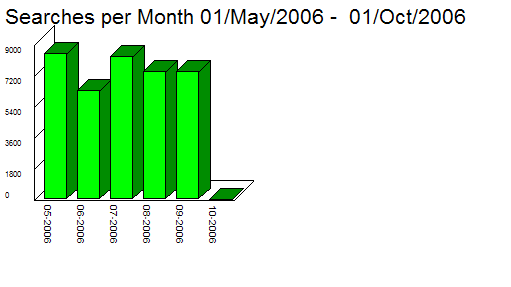
As you will all know, we also have a search engine on the COCP web site. Here are the some of the stats for September.


Saturday, September 30, 2006

Warwickshire Farewell

It is six years since, encouraged by the easy start-up of the Cornish 1891 project, I decided to run a similar project for the Warwickshire 1891 returns. At first, the project only covered the districts of Aston and Birmingham, because all my ancestral lines lived in Aston from 1845 onwards. But gradually, the project grew till it covered the whole of Warwickshire – 122 “pieces” that eventually produced about 780,000 records.

Each record has been transcribed, checked, validated and generally buffed up; finally being uploaded to Free Census and to the Warwickshire web site run by Pickard Trepess. Each piece was produced from a 3 or 4 fiche set, loaned to me by the Church of Latter-Day Saints of Jesus Christ – the LDS or Mormons. Transcribers, living anywhere from Hong Kong to Vancouver via Australia and New Zealand, transcribed the contents of the fiche set to produce a data file that was then sent to a checker. The checkers worked their way through the data, identifying and fixing errors. Finally, I validated the work, ending up with a data file for uploading to Free Census. This file also went to Pickard to convert to html for his web pages.

About 150 people worked on the project and a list will be published shortly. I would like to particularly mention Jeanagh Punter, who for several years worked as the project recruiter and Pickard, who not only produces the html files and hosts the web site, but for the early years was an invaluable help with “technical” issues. I do have another list, luckily a lot shorter, of those people who vanished with the microfiche set. I won’t publish that. An even sadder list is of the five people who died “in harness”; one of them only a couple of weeks ago. This last one, an Australian, had worked on the project from the very beginning. I owe him, and all the other the other volunteers, a great debt.

What now? First I shall cut a disc containing the data and send it to the Mormons, The National Archives and the Archive of Historical Data at the University of Essex. I might also send a copy to the various societies engaged in Warwickshire family history; although none of them have ever shown the slightest interest in the project. Then I shall settle down to a slow steady review of the lot – to try and eliminate some of the uncertainties and to incorporate the corrections that kind people have emailed in.

I am not going to do any more Warwickshire census returns, but I wish the organiser of the 1861 project all the best and hope that someone somewhere will be encouraged enough by my words to start up the 1871 project! Better than watching television!

Friday, September 29, 2006

Public Relations No 3

The Cornwall online Census Project aims to transcribe all the Cornish 19th century census returns and make them accessible online free of charge. You’ll find the complete 1841 and 1891 censuses for Cornwall already online at http://freepages.genealogy.rootsweb.com/~kayhin/ukocp.html as is 83 per cent of the 1851 census, 96 per cent of the 1861, 35 per cent of the 1871, and seven per cent of the 1881. There area also three pieces (donated and unchecked) for the 1901 census.

Most of the transcribed records are also available at http://www.freecen.org.uk/ – the Free Census Project site.

The Online Parish Clerk scheme began in Cornwall about five years ago and has spread to Cumberland & Westmorland, Devon, Dorset, Kent, Lancashire, Sussex, Warwickshire and Wiltshire. Volunteers adopt one or more parishes and collect family history information about the parishes, offering free ‘look-ups’ for researchers.

You can now search a combined database at http://www.cornwall-opc-database.org/ which contains around 330,000 records from the Cornish OPCs. At present, the information is mainly from Church of England parish registers, but Nonconformist registers and other records are expected to be included in the future.

Four volunteers are currently transcribing births, marriages and deaths from the 19th century West Briton and Cornwall Advertiser newspaper, plus court cases. Go to http://freepages.genealogy.rootsweb.com/~wbritonad/cornwall/intro.html to view the transcripts.


[Published in the October 2006 edition of Practical Family History magazine]

Public Relations No 2

Cornwall is an unusual English county, not least because many people will tell you that it is not English or a county! It is also unusual in that it is further advanced towards becoming fully online, as far as family history research is concerned. As the organiser of the Cornwall Online Census project I thought I would let other readers know what online resources are available to Cornish researchers.

At the centre of Cornish online research are the Cornish GENUKI pages (http://www.genuki.org.uk/big/eng/Cornwall/). These provide links to anything and everything to do with Cornish family history. The pages are organised on a hierarchical basis and lead to some 260 town and parish pages and some more general pages. Normally GENUKI aims to use the county and parishes as they were in 1850 but these Cornish pages also include new parishes created towards the end of the 19th century. The Cornish GENUKI pages are constantly being updated, so it is worth checking them frequently.

We started the Cornwall Online Census Project in the summer of 2000, transcribing the 1891 returns from fiche supplied by the LDS. Within 18 months the first returns were online having gone through the process of transcription, checking and validation. By 1st July this year the 1841 and 1891 censuses were complete along with 90 per cent of the 1851 & 1861; 40 per cent of the 1871; and ten per cent of the 1881). The aim of the project is to transcribe all the Cornish 19th census returns and place them online free-to-view at http://freepages.genealogy.rootsweb.com/~kayhin/ukocp.html.

We also have an online parish clerk scheme, which started in Cornwall about four years ago and has now spread to half a dozen other counties. Volunteers adopt a parish or parishes and seek to accumulate information and data about their parish. Their primary aim is to offer free “look ups” for researchers, using via the Cornish mailing lists. The OPC scheme has now launched its own searchable online “free-to-view” database (http://www.cornwall-opc-database.org/). Starting just over a month ago it already has over a quarter of a million records online. At present it is concentrating on Church of England registers, but its scope will expand to cover non-conformist registers and other types of data (burials for example).

There are two Cornish mailing lists. The main Cornish list, Cornish-L, is for all things Cornish, while Cornish-GEN is a list strictly for family history. The Cornish-L list is home to the famous (or infamous) virtual Christmas party! Details of how to subscribe can be found at Rootsweb.

[published in November 2006 edition of Family History Monthly]

Public Relations No 1

Hello folks

I have just managed to get pieces about Cornwall online activities published in two of the three main UK family history magazines. Both pieces will follow this one. The first one was published as a letter; the second as a small piece. Both pieces are edited versions of my text.

My aim in this is twofold. First of all - there is no point in our doing all this work, if no one knows about it. Secondly, it might recruit more people to help us in our great task.

My aim in publishing the pieces on here is to encourage you all to try your hand in your own countries. Most of the English speaking world now enjoys any number of paper and electronic FH magazines. You don't have to slavishly lift my words, feel free to edit or rewrite as you see fit. But do have a go.

Don't forget to let me know if you have any success.

Rgds

Michael

Wednesday, September 27, 2006

Newsletter No 14

Hello folks

In addition to taking a week's holiday, I am also struggling with computer problems. All my own fault as well. Much of the information I need access to is on the computer that is now in hospital; and as I expect it back every day, I haven't bothered to install it on this machine.

In spite of things generally, a considerable amount of work has been completed. Some five 1851 parishes have gone, or are about to go, online. Plus a similiar number of 1871 pieces and a couple of 1881. The 1861 is on its last three pieces.

On the wider scene, I have just finished the last of the 122 Warwickshire 1891 pieces. Only took six years. 780,000 records, all transcribed and online, for free.

I am hoping that the 1861 will be finished by the end of the year, followed soon after by the 1851.

It would be nice to hear from everyone!

Thursday, September 07, 2006

COCP General Instructions Pt 2

Project transcription software.

You are transcribing from discs lent to us by the LDS. The copyright is quite clear. Copyright in the images and contents of UK census returns is held by the Crown. The Crown has waived its copyright for the contents and licensed the copying of the images for commercial profit. Any transcription is the copyright of the transcriber, given that the Crown has waived its copyright. The transcriber can do with it what he or she likes, including giving it to Free Census. We have that in writing from the PRO.

Each transcriber will be supplied with five files. Three are browser files and tell you everything you need to know! There are also two spreadsheet files. Any spreadsheet will do. CENSDEMO shows you what your spreadsheet should look like when you have got going. The other is your working spreadsheet. This is a templated spreadsheet whose main effect is to prevent transcribers exceeding the set column widths.

If you are an Apple user or do not have a floppy drive, please contact me before you try start work.

When you open this spreadsheet, you will see that the first three rows are completed for you. The first has the piece number, the second has the column headings, the third lots of lower case letters. These are there to indicate to you the maximum width you are to work to in each column. These three rows must be left intact. The spreadsheet supplied is designed to stop you exceeding this column width.

It can be saved as a spreadsheet but as it gets larger you may need to do your backups as .csv files. Tell me if you do not know about csv formatting. You should do regular backups to floppies or some other medium. Please do not omit this precaution.

Bill O'Reilly will also conduct a ‘health’ check on your first six or so pages. Please do this because not only is it easier to catch mistakes early on, but it will let us know you have actually started. Just email your file to him. You can request these health checks at any time.

You will be allocated a piece to do although the disc supplied may have several pieces on it. This piece will have up to 3,000 records on some 150 pages. 1861 pieces are larger than those of the 1871. However, some of these pages will contain little or no data to be transcribed. How you do it is up to you. You can transcribe direct into the software or to paper.

Monday, August 28, 2006

COCP Newsletter No 13

Hello folks

The grandchildren have all gone; covered in salt, sweat & sand. Well, I was. They had their first taste of surf school and have already checked that they can come again next year. Throwing out the empties made me realise that we had also drunk a lot of wine! The adults not the grandchildren.

It has been reported that spring in Europe this year was about 4 weeks early - except for SW England, where it was on time. There is a faint touch of autumn about the weather at the moment in Cornwall - which suggests to me that Autumn is 4 weeks early!

Now I am up to my neck in census returns; Cornish, North Wilts AND Warwickshire. As Rick is away till later this week, nothing will be published for a couple of weeks.

A few pointers. Did you know that if you write RN in the occupation field, it will come out as Rn? You must have a space to make it capitalise. Text in the notes field does not capitalise. If you don't put in the capital letters, then you will get r n and I will have to alter it.

Some people are overdoing the abbreviations. You have 29 spaces, please use them. So "a" for acres, but 1m can be entered in full. It looks better, or at least, I think it does. If you are using a templated spreadsheet, then you only have 22 spaces for occupation. One of these days I will fix that. You can always use the notes field, but I would rather you got it all in the occupation field, as long as it makes sense and looks nice!

Indicates of rank etc, Esquire, Lord, Senior and Junior, are all entered after the forename. (Esq), (Lord), (Snr) & (Jnr) and so on.

I am going to publish the General Instructions on this blog, starting now. Please re-read them, especially the paragraphs on place born.

Rgds

Michael

Sunday, August 06, 2006

NWOCP Newsletter No 3

Hello folks

Greetings from Cornwall, where the summer visitor is in full flood (see earlier COCP newsletter).

In our 8th month now and we are starting to see a steady flow of completed pieces. We have done and put online:

RG091275 Cricklade
RG101876 Highworth
RG101877 Highworth
RG101901 Calne
Rg101902 Calne
RG101904 Marlborough
RG101905 Marlborough.

Almost all the 1861 & 1871 pieces are being worked on, with a number being checked. Our first 1891 piece has been transcribed and I have a checker lined up for that. About a dozen 1841 parishes are transcribed and as soon as I can find some more checkers I will start pushing the 1841 for completion. Free Census have now produced the data file required for checking.

All our work is going online on http://www.pope-genealogy.me.uk/nwocp.htm and on the main Free Census online database. Please take a look at our web site and browse the stuff on this blog - there might be something for you!

Recently, a couple of volunteers have recruited relatives and friends; if you know someone who might be interested, please get them to drop me a line.

Saturday, August 05, 2006

Advice for transcribers

Hello folks

Recently I asked two of our most experienced checkers for some general advice for transcribers. The second checker's comments are in brackets. They have both just finished very large 1851 pieces.

1. Since the programme (Excel) has a memory function, they should be careful using it. The transcriber must have spelled 'Louisa' as 'Lousia' the first time and never bothered to look at what he/she was typing after that. In the same way 'Ellen' showed up as 'Ellen Ann' after that.

2. Do use the resources of the net, et cetera when coming upon a strange name. I constantly had to go to 1841 or 1861 or 1881 to make corrections of names that were not all that difficult to read. [Michael: I use Google a lot, it will often give hits on place & personal names]

3. Be aware of gender - I often had a Francis, son, given as Female. (I find that if the transcriber misreads a name, then the rest of the tx'd data is often wrongly adjusted to match the misreading eg relationship & gender.)

4. Check birth towns. There is no Bugle in Cornwall but there is a Breage. [Michael: Six miles from where I am sitting is a village called Bugle!!!!!] (I just keep the GENUKI big/eng page open and refer to that. If it says Bugle CON, then it'll get checked as Bugle CON.)

5. If a transcriber comes upon an unreadable name and three lines later the same name is now written more clearly, go back and make the correction to the name instead of leaving the job to the checker.

6. If a transcriber wants to type in a wife's occupation as 'miner' or 'fisherman', he/she should realize that the occupation has probably been transcribed to the wrong person. (yes ... but if it's what the enumerator wrote (as is sometimes the case) then so be it.)

7. Do use software, where possible, to improve the quality of the original page - I use Adobe Photoshop to sharpen and improve the contrast. (Never yet needed to do it, but agree. With a flat screen you can often view it off angle to achieve some change of colour/contrast etc.)

(8. Quite often I find lines are transposed or translated mid-line (maths term ie shifted) ... I'm guessing that the transcriber is going down the page in columns, and I'm checking left to right. But it is a real pain with WINCC to put the lines back together again.) [Michael: This might be my fault - as I often advise transcribers to transcribe vertically]

(9. Also it might seem obvious but married couples usually tend to have similar ages with children aged at least 20 years less than the younger of the two. Yes I know there are exceptions, but it does beg a double check when transcribing.)

(10. Servants, lodgers, boarders, visitors, in-laws etc usually have a different surname to the main household.)

(But I do pity anyone battling with the fiche scans of 1851. They're very variable. Ancestry's done a much better job scanning at least, though their index is a little fanciful at times.)

COCP Newsletter No 12

Hello folks


First wave of grandchildren leave tomorrow morning; second wave arrives on Monday afternoon; 3rd wave the following Sunday. Even so, we have managed to keep the show on the road.

We are now down to the last five pieces of the 1861; might be finished in October. 25 of the 235 1851 parishes remain to be completed and about half the 1871. More of the 1881 is now being tackled, with a couple of new checkers arriving.

I would like to remind everyone that our aim is to reproduce what the enumerator wrote - "as is". Not what he should have wrote (it is nearly always a him); but what he actually wrote. If he has a 70 year-old woman with a five-year old son don't bother to flag it up or write me a note that it is obviously not a son.

On place of birth names, someone pointed out to me recently that it would be difficult to search for a parish name on the Free Census OLDB, because many of our transcripts (although "as is") have variations on the modern names. I am afraid that we are between a rock and a hard place on this one. Because we also put our returns online as texts, we don't believe this is an unsurmountable problem for researchers. And it is nice to leave them something to do......

Is everyone aware of C-PROP on http://www.cornwall-opc.org/search/ ? Currently it has 326,931 parish records online - all FREE! We are concentrating on CoE records at the moment, but have also started to extract the data from the West Briton project. If you have any transcripts - why not send them in - we will sort them out for uploading.

This project is built on the use of emails. You can, and should, be dropping Kay or myself or both of us, an occasional line saying how things are going. Don't leave us in the dark. There is also the alternative of using Instant Messaging. There is an earlier piece on this blog about jabber. Try it out and you might get an instant response. You can use it for census queries or anything else. Do I, for instance, know your great aunt Ethel? You never know.....

If you have tried Google Earth, it has recently released v4. It has a really nice shot of Mitchell, my home village; you can almost see me waving from the top of my jungle (garden)

Rgds

Michael

Thursday, July 20, 2006

COCP Newsletter No 11

Thick mist in my part of Cornwall and I am about to depart for England. About 7 hours of motoring misery - and that is only if I am lucky. Back online on Monday morning.

This week saw a couple of pieces uploaded, several more are in post validation and I have three pieces here ready to be validated. As I am going to England to pick up a couple of grandchildren, census returns are likely to be stacked for now!

Currently, we are within a month or so of completing the 1861, with only five pieces left to do. The 1851 won't be far behind and the 1871 is approaching 50%. This week we recruited three more people. They all want to be transcribers, but we don't have work for them. We are now in the end game period of the whole Cornish project - not just the 61 & 51. More and more volunteers must be persuaded to switch to checking; there are already plenty of 1871 pieces waiting for checking.

The big task is the 1881. We have a transcript of the whole of the Cornish 1881; it just needs checking. So everyone who sticks with us will have to try their hand at checking. You might ask why we are doing the 1881. Well, wonderful though the LDS version is, we are finding mistakes as we compare our transcript with theirs. Anyway - there is question of symetry! How nice to have the whole of the Cornish 19th century returns online!

Checking is less painful than transcribing - and I have tried both! You have to tab through each field of each record, looking closely at the transcriber's work. If you find mistakes - and you will - you fix them. If you can't, you flag them up for me to look at during validation. Checking is a vital part of the project and has to be done properly. It is not difficult - just hard on the tab key!

So - be prepared - a grovelling email will arrive one day asking that you volunteer to try checking.

The Free Census database was rebuilt on July 12th and the Cornish volunteers remain by far the biggest contributors to the nearly 8 million records now online.

Onwards and Upwards!

Wednesday, July 12, 2006

NWOCP Newsletter No 2

We now have our own web site (http://www.pope-genealogy.me.uk/nwocp.htm) courtesy of John Pope. On this you can see those pieces that we have completed – four 1871 and one 1861. The 60 or so pieces that make up the Nth Wilts coverage for those two years are all being worked on.

Most of the 1841 for Nth Wilts is also being tackled, with a steady flow of parishes arriving from transcribers. Finally, three people, equipped with microfiche readers, are working on the 1891.

Several people have joined the project this week, but we can always use more. If you have friends or family who would like to help out – drop me a line.

The next hurdle is to get the necessary data file constructed by Free Census, so that I can get checkers to work on the 1841. These will be posted by parish to our own web site.

Please stay in touch; don’t leave me in the dark!

COCP Newsletter No 10


Ann & Michael

This picture has nothing much to do with anything!

Slow week on the census front this week, with nothing much happening. So I have been busy with C-PROP stuff - the new Cornish Parish Registers project. Over a quarter of a million records online and rising.

If anyone wants to drop me a line and tell me your woes or good news - please do so!

Rgds

Michael

The COCP and Birth place data

The guiding principle of the COCP is to transcribe “as is”. When applied to the place of birth data, this produces a slight problem. Many of the Cornish place names have a number of variations in spelling. St Hilary is a good example; there are about six different ways of spelling it and they can all come with or without the “St”. However, we are not conducting family history research; we are providing a tool for those people who are. They ought to be able to work out what the place name is on their own.

The book I often quote, by Edward Higgs, says that Cornwall is particularly prone to variations in place name spellings.

The enumerator’s instructions asked that from 1851 onwards, householders state the county and parish or town of birth. Frequently, the place named is a farm or other place, not a parish or town. Sometimes, even a street name or other address is given.

We just transcribe the enumerator’s words.

The enumeration instructions only required the county name for Irish or Scots. If, like me, you have Irish ancestors, this is particularly annoying. Its even worse when they just say Ireland or Scotland. For places like London, where all it says is London, this is treated as a county; just enter LND in the County field and a hyphen for place born.

Now for an innovation – a competition! There will be a prize for the volunteer who can explain to me why no one uses the Chapman codes for Irish Counties. It is not just the COCP volunteers, the Nth Wilts and Warwickshire ones are just the same. I am not sure what the prize will be for the best explanation – I’ll think of something.

Tuesday, July 11, 2006

Census Birth Place Data

The quality of the birthplace data in the 1841 census is far from satisfactory. The household schedule contained two columns for this information headed ‘Whether born in the same county’ and ‘Whether born in Scotland, Ireland, or Foreign Parts’. Householders were instructed to write ‘yes’ or ‘no’ in the first column. In the second they were to write ‘Scotland’, ‘Ireland’ or ‘Foreigner’. The latter designation only referred to those born outside the UK who were not British subjects. Those born abroad who were British subjects were to be entered in the firsts column with the word ‘No’. The number of British subjects born outside the UK but resident there in 1841 cannot, therefore, be calculated. The enumerators were instructed to abbreviate these entries when copying them into their enumeration books, using ‘Y’, ‘N’, ‘S’, ‘I’ and ‘F” respectively.

In 1851 more informative answers were required. In the case of those born in England, householders were to indicate first the county, and then the town or parish of birth. This order was to be followed in all subsequent Victorian censuses. In the case of those born in Scotland, Ireland, the British Colonies, the East Indies or Foreign Parts, the country of birth was to be stated. The term ‘British Subject’ was to be added to the latter where appropriate. Interestingly, Wales was not mentioned in the instructions on this matter until 1891, when the principality was treated in the same manner as England. Presumably the Welsh had simply been overlooked, and this may affect the form of some entries. Some other minor changes were introduced in the course of the century. In 1861 a distinction was to be made between ‘British Subject’ and ‘naturalised British Subject’. In 1871 those born in Scotland, Ireland, the British Colonies or the East Indies were to state the country or colony of birth; and those born in Foreign Parts the particular state or country.

One may have doubts as to the extent to which householders understood the instructions with regard to those born outside the UK, but those relating to people born in England, Scotland and Ireland appear fairly straightforward. It may be something of a surprise therefore, to discover that the chief clerk of the GR in 1910 said:

“the birthplace tables were probably the most inaccurate of any of the Census Tables but feared they could not be dispensed with as some people seemed to attach considerable importance to the figures. Not only did a great many people not know in which county they were born but a place which was now a town might easily have been a small village at the time of the birth of persons aged 20 years and upwards who were enumerated in other towns.”

Occasionally the grasp of British geography shown by households and enumerators was not strong. However, the 19th century was a period of great re-organisation in local government, and some changes in the county of birth may reflect boundary changes. There was also a tendency to record the place of residence, or the earliest one which could be remembered, as the place of birth. In institutions such as workhouses there appears to be a propensity on the part of some returning officers to give the location of the institution as the place of birth.

Making Sense of the Census Revisited by Edward Higgs. Copyright TNA

Sunday, July 02, 2006

COCP Newsletter No 9

During June the COCP uploaded three 1861 pieces, ten 1871 & one 1881 piece. Well, it will have any moment now! Another 1861 piece is in the works, which means we are down to the last five pieces of the census out of 89.

There are about 20 parishes of the 1851 left to do, out of over 200. All are being worked on and could be finished soon. We are still recruiting people but are increasingly starting them off on checking rather than transcribing.

This year should see the completion of the 1851 & 61 projects and Rick is already working on the 1861 disc. We are really rolling on the 1871 and should complete that by the middle of next year. The 1881 is a big task, but we have a complete transcription already and if people are willing to move over to checking, it shouldn't take too long.

On the wider front, Free Census managed a rebuild on 24th June and the COCP now has 1,254,528 records online with them. One in seven of the records they have are the product of the COCP and its volunteers. If only the rest of them would get on with as we do!

The Warwickshire 1891 project is nearly complete. The penultimate piece is about to go online, leaving only one piece out of 122 to be completed. The North Wilts project is speeding up with the 4th piece completed and online on its own web site.

The Cornish OPC scheme has its online db up and running with over 200,000 records already uploaded. If any of you have parish register transcripts, why not send them in? 10 or 10,000, all are very welcome.

Monday, June 05, 2006

COCP Newsletter No 8

Hello folks

The sun is shining in Cornwall! I should be gardening, but when I get up there I just sit and look at it all growing - weeds and plants!

While I have been away you have all been busy - three 1871 pieces and one 1861 have come in. They should all be online in a week or so.

Once a month, Rick produces stats for the COCP search engine. For May it never took less than 200 searches per day, and most well above that, several times hitting 400. This is a good indication of how much your work is being used - which of course, is the whole point.

The sister project of the COCP is C-PROP, the Online Parish Register Project. The database is now up and running and we have started to upload transcripts. At the moment we are trying to restrict use to the OPC scheme members, but I will keep you posted.

A subject that comes up quite often is the UK 2011 census returns. The National Archives have just said:

"The 1911 census is a huge document – more than 12 times the size of the 1901 census, with 35,000 volumes containing the details of our 35 million ancestors and occupying some 2 kilometres of shelving. They are in good condition and suitable for scanning, with less than 5 per cent requiring more extensive conservation work to be scanned safely.

By far the best option for providing access to the census is online delivery, making the returns available to the widest possible audience and preserving the integrity of the original records. Proposals are well underway to find the very best company to work with us in order to provide a good reliable service for millions of potential users. We have published our requirements in the Official Journal of the European Union and over the next couple of months will seek to create a shortlist of potential suppliers.

Learning from previous experience and building on our current plans, The National Archives is eagerly looking forward to launching the 1911 census online in January 2012."

These returns are the actual householder schedules; not enumerators' books. This is good news, because up to now rumour control has had it that this was mission impossible.

As this is so long, I will cut out the usual whinging! And just take the opportunity to thank you all again for all your support.

Onward and Upward!!!!!