It is six years since, encouraged by the easy start-up of the Cornish 1891 project, I decided to run a similar project for the Warwickshire 1891 returns. At first, the project only covered the districts of Aston and Birmingham, because all my ancestral lines lived in Aston from 1845 onwards. But gradually, the project grew till it covered the whole of Warwickshire – 122 “pieces” that eventually produced about 780,000 records.
Each record has been transcribed, checked, validated and generally buffed up; finally being uploaded to Free Census and to the Warwickshire web site run by Pickard Trepess. Each piece was produced from a 3 or 4 fiche set, loaned to me by the Church of Latter-Day Saints of Jesus Christ – the LDS or Mormons. Transcribers, living anywhere from Hong Kong to Vancouver via Australia and New Zealand, transcribed the contents of the fiche set to produce a data file that was then sent to a checker. The checkers worked their way through the data, identifying and fixing errors. Finally, I validated the work, ending up with a data file for uploading to Free Census. This file also went to Pickard to convert to html for his web pages.
About 150 people worked on the project and a list will be published shortly. I would like to particularly mention Jeanagh Punter, who for several years worked as the project recruiter and Pickard, who not only produces the html files and hosts the web site, but for the early years was an invaluable help with “technical” issues. I do have another list, luckily a lot shorter, of those people who vanished with the microfiche set. I won’t publish that. An even sadder list is of the five people who died “in harness”; one of them only a couple of weeks ago. This last one, an Australian, had worked on the project from the very beginning. I owe him, and all the other the other volunteers, a great debt.
What now? First I shall cut a disc containing the data and send it to the Mormons, The National Archives and the Archive of Historical Data at the University of Essex. I might also send a copy to the various societies engaged in Warwickshire family history; although none of them have ever shown the slightest interest in the project. Then I shall settle down to a slow steady review of the lot – to try and eliminate some of the uncertainties and to incorporate the corrections that kind people have emailed in.
I am not going to do any more Warwickshire census returns, but I wish the organiser of the 1861 project all the best and hope that someone somewhere will be encouraged enough by my words to start up the 1871 project! Better than watching television!
Saturday, September 30, 2006

Friday, September 29, 2006
Public Relations No 3
The Cornwall online Census Project aims to transcribe all the Cornish 19th century census returns and make them accessible online free of charge. You’ll find the complete 1841 and 1891 censuses for Cornwall already online at http://freepages.genealogy.rootsweb.com/~kayhin/ukocp.html as is 83 per cent of the 1851 census, 96 per cent of the 1861, 35 per cent of the 1871, and seven per cent of the 1881. There area also three pieces (donated and unchecked) for the 1901 census.
Most of the transcribed records are also available at http://www.freecen.org.uk/ – the Free Census Project site.
The Online Parish Clerk scheme began in Cornwall about five years ago and has spread to Cumberland & Westmorland, Devon, Dorset, Kent, Lancashire, Sussex, Warwickshire and Wiltshire. Volunteers adopt one or more parishes and collect family history information about the parishes, offering free ‘look-ups’ for researchers.
You can now search a combined database at http://www.cornwall-opc-database.org/ which contains around 330,000 records from the Cornish OPCs. At present, the information is mainly from Church of England parish registers, but Nonconformist registers and other records are expected to be included in the future.
Four volunteers are currently transcribing births, marriages and deaths from the 19th century West Briton and Cornwall Advertiser newspaper, plus court cases. Go to http://freepages.genealogy.rootsweb.com/~wbritonad/cornwall/intro.html to view the transcripts.
Most of the transcribed records are also available at http://www.freecen.org.uk/ – the Free Census Project site.
The Online Parish Clerk scheme began in Cornwall about five years ago and has spread to Cumberland & Westmorland, Devon, Dorset, Kent, Lancashire, Sussex, Warwickshire and Wiltshire. Volunteers adopt one or more parishes and collect family history information about the parishes, offering free ‘look-ups’ for researchers.
You can now search a combined database at http://www.cornwall-opc-database.org/ which contains around 330,000 records from the Cornish OPCs. At present, the information is mainly from Church of England parish registers, but Nonconformist registers and other records are expected to be included in the future.
Four volunteers are currently transcribing births, marriages and deaths from the 19th century West Briton and Cornwall Advertiser newspaper, plus court cases. Go to http://freepages.genealogy.rootsweb.com/~wbritonad/cornwall/intro.html to view the transcripts.
[Published in the October 2006 edition of Practical Family History magazine]
Public Relations No 2
Cornwall is an unusual English county, not least because many people will tell you that it is not English or a county! It is also unusual in that it is further advanced towards becoming fully online, as far as family history research is concerned. As the organiser of the Cornwall Online Census project I thought I would let other readers know what online resources are available to Cornish researchers.
At the centre of Cornish online research are the Cornish GENUKI pages (http://www.genuki.org.uk/big/eng/Cornwall/). These provide links to anything and everything to do with Cornish family history. The pages are organised on a hierarchical basis and lead to some 260 town and parish pages and some more general pages. Normally GENUKI aims to use the county and parishes as they were in 1850 but these Cornish pages also include new parishes created towards the end of the 19th century. The Cornish GENUKI pages are constantly being updated, so it is worth checking them frequently.
We started the Cornwall Online Census Project in the summer of 2000, transcribing the 1891 returns from fiche supplied by the LDS. Within 18 months the first returns were online having gone through the process of transcription, checking and validation. By 1st July this year the 1841 and 1891 censuses were complete along with 90 per cent of the 1851 & 1861; 40 per cent of the 1871; and ten per cent of the 1881). The aim of the project is to transcribe all the Cornish 19th census returns and place them online free-to-view at http://freepages.genealogy.rootsweb.com/~kayhin/ukocp.html.
We also have an online parish clerk scheme, which started in Cornwall about four years ago and has now spread to half a dozen other counties. Volunteers adopt a parish or parishes and seek to accumulate information and data about their parish. Their primary aim is to offer free “look ups” for researchers, using via the Cornish mailing lists. The OPC scheme has now launched its own searchable online “free-to-view” database (http://www.cornwall-opc-database.org/). Starting just over a month ago it already has over a quarter of a million records online. At present it is concentrating on Church of England registers, but its scope will expand to cover non-conformist registers and other types of data (burials for example).
There are two Cornish mailing lists. The main Cornish list, Cornish-L, is for all things Cornish, while Cornish-GEN is a list strictly for family history. The Cornish-L list is home to the famous (or infamous) virtual Christmas party! Details of how to subscribe can be found at Rootsweb.
[published in November 2006 edition of Family History Monthly]
At the centre of Cornish online research are the Cornish GENUKI pages (http://www.genuki.org.uk/big/eng/Cornwall/). These provide links to anything and everything to do with Cornish family history. The pages are organised on a hierarchical basis and lead to some 260 town and parish pages and some more general pages. Normally GENUKI aims to use the county and parishes as they were in 1850 but these Cornish pages also include new parishes created towards the end of the 19th century. The Cornish GENUKI pages are constantly being updated, so it is worth checking them frequently.
We started the Cornwall Online Census Project in the summer of 2000, transcribing the 1891 returns from fiche supplied by the LDS. Within 18 months the first returns were online having gone through the process of transcription, checking and validation. By 1st July this year the 1841 and 1891 censuses were complete along with 90 per cent of the 1851 & 1861; 40 per cent of the 1871; and ten per cent of the 1881). The aim of the project is to transcribe all the Cornish 19th census returns and place them online free-to-view at http://freepages.genealogy.rootsweb.com/~kayhin/ukocp.html.
We also have an online parish clerk scheme, which started in Cornwall about four years ago and has now spread to half a dozen other counties. Volunteers adopt a parish or parishes and seek to accumulate information and data about their parish. Their primary aim is to offer free “look ups” for researchers, using via the Cornish mailing lists. The OPC scheme has now launched its own searchable online “free-to-view” database (http://www.cornwall-opc-database.org/). Starting just over a month ago it already has over a quarter of a million records online. At present it is concentrating on Church of England registers, but its scope will expand to cover non-conformist registers and other types of data (burials for example).
There are two Cornish mailing lists. The main Cornish list, Cornish-L, is for all things Cornish, while Cornish-GEN is a list strictly for family history. The Cornish-L list is home to the famous (or infamous) virtual Christmas party! Details of how to subscribe can be found at Rootsweb.
[published in November 2006 edition of Family History Monthly]
Public Relations No 1
Hello folks
I have just managed to get pieces about Cornwall online activities published in two of the three main UK family history magazines. Both pieces will follow this one. The first one was published as a letter; the second as a small piece. Both pieces are edited versions of my text.
My aim in this is twofold. First of all - there is no point in our doing all this work, if no one knows about it. Secondly, it might recruit more people to help us in our great task.
My aim in publishing the pieces on here is to encourage you all to try your hand in your own countries. Most of the English speaking world now enjoys any number of paper and electronic FH magazines. You don't have to slavishly lift my words, feel free to edit or rewrite as you see fit. But do have a go.
Don't forget to let me know if you have any success.
Rgds
Michael
I have just managed to get pieces about Cornwall online activities published in two of the three main UK family history magazines. Both pieces will follow this one. The first one was published as a letter; the second as a small piece. Both pieces are edited versions of my text.
My aim in this is twofold. First of all - there is no point in our doing all this work, if no one knows about it. Secondly, it might recruit more people to help us in our great task.
My aim in publishing the pieces on here is to encourage you all to try your hand in your own countries. Most of the English speaking world now enjoys any number of paper and electronic FH magazines. You don't have to slavishly lift my words, feel free to edit or rewrite as you see fit. But do have a go.
Don't forget to let me know if you have any success.
Rgds
Michael
Wednesday, September 27, 2006
Newsletter No 14
Hello folks
In addition to taking a week's holiday, I am also struggling with computer problems. All my own fault as well. Much of the information I need access to is on the computer that is now in hospital; and as I expect it back every day, I haven't bothered to install it on this machine.
In spite of things generally, a considerable amount of work has been completed. Some five 1851 parishes have gone, or are about to go, online. Plus a similiar number of 1871 pieces and a couple of 1881. The 1861 is on its last three pieces.
On the wider scene, I have just finished the last of the 122 Warwickshire 1891 pieces. Only took six years. 780,000 records, all transcribed and online, for free.
I am hoping that the 1861 will be finished by the end of the year, followed soon after by the 1851.
It would be nice to hear from everyone!
In addition to taking a week's holiday, I am also struggling with computer problems. All my own fault as well. Much of the information I need access to is on the computer that is now in hospital; and as I expect it back every day, I haven't bothered to install it on this machine.
In spite of things generally, a considerable amount of work has been completed. Some five 1851 parishes have gone, or are about to go, online. Plus a similiar number of 1871 pieces and a couple of 1881. The 1861 is on its last three pieces.
On the wider scene, I have just finished the last of the 122 Warwickshire 1891 pieces. Only took six years. 780,000 records, all transcribed and online, for free.
I am hoping that the 1861 will be finished by the end of the year, followed soon after by the 1851.
It would be nice to hear from everyone!
Thursday, September 07, 2006
COCP General Instructions Pt 2
Project transcription software.
You are transcribing from discs lent to us by the LDS. The copyright is quite clear. Copyright in the images and contents of UK census returns is held by the Crown. The Crown has waived its copyright for the contents and licensed the copying of the images for commercial profit. Any transcription is the copyright of the transcriber, given that the Crown has waived its copyright. The transcriber can do with it what he or she likes, including giving it to Free Census. We have that in writing from the PRO.
Each transcriber will be supplied with five files. Three are browser files and tell you everything you need to know! There are also two spreadsheet files. Any spreadsheet will do. CENSDEMO shows you what your spreadsheet should look like when you have got going. The other is your working spreadsheet. This is a templated spreadsheet whose main effect is to prevent transcribers exceeding the set column widths.
If you are an Apple user or do not have a floppy drive, please contact me before you try start work.
When you open this spreadsheet, you will see that the first three rows are completed for you. The first has the piece number, the second has the column headings, the third lots of lower case letters. These are there to indicate to you the maximum width you are to work to in each column. These three rows must be left intact. The spreadsheet supplied is designed to stop you exceeding this column width.
It can be saved as a spreadsheet but as it gets larger you may need to do your backups as .csv files. Tell me if you do not know about csv formatting. You should do regular backups to floppies or some other medium. Please do not omit this precaution.
Bill O'Reilly will also conduct a ‘health’ check on your first six or so pages. Please do this because not only is it easier to catch mistakes early on, but it will let us know you have actually started. Just email your file to him. You can request these health checks at any time.
You will be allocated a piece to do although the disc supplied may have several pieces on it. This piece will have up to 3,000 records on some 150 pages. 1861 pieces are larger than those of the 1871. However, some of these pages will contain little or no data to be transcribed. How you do it is up to you. You can transcribe direct into the software or to paper.
You are transcribing from discs lent to us by the LDS. The copyright is quite clear. Copyright in the images and contents of UK census returns is held by the Crown. The Crown has waived its copyright for the contents and licensed the copying of the images for commercial profit. Any transcription is the copyright of the transcriber, given that the Crown has waived its copyright. The transcriber can do with it what he or she likes, including giving it to Free Census. We have that in writing from the PRO.
Each transcriber will be supplied with five files. Three are browser files and tell you everything you need to know! There are also two spreadsheet files. Any spreadsheet will do. CENSDEMO shows you what your spreadsheet should look like when you have got going. The other is your working spreadsheet. This is a templated spreadsheet whose main effect is to prevent transcribers exceeding the set column widths.
If you are an Apple user or do not have a floppy drive, please contact me before you try start work.
When you open this spreadsheet, you will see that the first three rows are completed for you. The first has the piece number, the second has the column headings, the third lots of lower case letters. These are there to indicate to you the maximum width you are to work to in each column. These three rows must be left intact. The spreadsheet supplied is designed to stop you exceeding this column width.
It can be saved as a spreadsheet but as it gets larger you may need to do your backups as .csv files. Tell me if you do not know about csv formatting. You should do regular backups to floppies or some other medium. Please do not omit this precaution.
Bill O'Reilly will also conduct a ‘health’ check on your first six or so pages. Please do this because not only is it easier to catch mistakes early on, but it will let us know you have actually started. Just email your file to him. You can request these health checks at any time.
You will be allocated a piece to do although the disc supplied may have several pieces on it. This piece will have up to 3,000 records on some 150 pages. 1861 pieces are larger than those of the 1871. However, some of these pages will contain little or no data to be transcribed. How you do it is up to you. You can transcribe direct into the software or to paper.
Monday, August 28, 2006
COCP Newsletter No 13
Hello folks
The grandchildren have all gone; covered in salt, sweat & sand. Well, I was. They had their first taste of surf school and have already checked that they can come again next year. Throwing out the empties made me realise that we had also drunk a lot of wine! The adults not the grandchildren.
It has been reported that spring in Europe this year was about 4 weeks early - except for SW England, where it was on time. There is a faint touch of autumn about the weather at the moment in Cornwall - which suggests to me that Autumn is 4 weeks early!
Now I am up to my neck in census returns; Cornish, North Wilts AND Warwickshire. As Rick is away till later this week, nothing will be published for a couple of weeks.
A few pointers. Did you know that if you write RN in the occupation field, it will come out as Rn? You must have a space to make it capitalise. Text in the notes field does not capitalise. If you don't put in the capital letters, then you will get r n and I will have to alter it.
Some people are overdoing the abbreviations. You have 29 spaces, please use them. So "a" for acres, but 1m can be entered in full. It looks better, or at least, I think it does. If you are using a templated spreadsheet, then you only have 22 spaces for occupation. One of these days I will fix that. You can always use the notes field, but I would rather you got it all in the occupation field, as long as it makes sense and looks nice!
Indicates of rank etc, Esquire, Lord, Senior and Junior, are all entered after the forename. (Esq), (Lord), (Snr) & (Jnr) and so on.
I am going to publish the General Instructions on this blog, starting now. Please re-read them, especially the paragraphs on place born.
Rgds
Michael
The grandchildren have all gone; covered in salt, sweat & sand. Well, I was. They had their first taste of surf school and have already checked that they can come again next year. Throwing out the empties made me realise that we had also drunk a lot of wine! The adults not the grandchildren.
It has been reported that spring in Europe this year was about 4 weeks early - except for SW England, where it was on time. There is a faint touch of autumn about the weather at the moment in Cornwall - which suggests to me that Autumn is 4 weeks early!
Now I am up to my neck in census returns; Cornish, North Wilts AND Warwickshire. As Rick is away till later this week, nothing will be published for a couple of weeks.
A few pointers. Did you know that if you write RN in the occupation field, it will come out as Rn? You must have a space to make it capitalise. Text in the notes field does not capitalise. If you don't put in the capital letters, then you will get r n and I will have to alter it.
Some people are overdoing the abbreviations. You have 29 spaces, please use them. So "a" for acres, but 1m can be entered in full. It looks better, or at least, I think it does. If you are using a templated spreadsheet, then you only have 22 spaces for occupation. One of these days I will fix that. You can always use the notes field, but I would rather you got it all in the occupation field, as long as it makes sense and looks nice!
Indicates of rank etc, Esquire, Lord, Senior and Junior, are all entered after the forename. (Esq), (Lord), (Snr) & (Jnr) and so on.
I am going to publish the General Instructions on this blog, starting now. Please re-read them, especially the paragraphs on place born.
Rgds
Michael
Sunday, August 06, 2006
NWOCP Newsletter No 3
Hello folks
Greetings from Cornwall, where the summer visitor is in full flood (see earlier COCP newsletter).
In our 8th month now and we are starting to see a steady flow of completed pieces. We have done and put online:
RG091275 Cricklade
RG101876 Highworth
RG101877 Highworth
RG101901 Calne
Rg101902 Calne
RG101904 Marlborough
RG101905 Marlborough.
Almost all the 1861 & 1871 pieces are being worked on, with a number being checked. Our first 1891 piece has been transcribed and I have a checker lined up for that. About a dozen 1841 parishes are transcribed and as soon as I can find some more checkers I will start pushing the 1841 for completion. Free Census have now produced the data file required for checking.
All our work is going online on http://www.pope-genealogy.me.uk/nwocp.htm and on the main Free Census online database. Please take a look at our web site and browse the stuff on this blog - there might be something for you!
Recently, a couple of volunteers have recruited relatives and friends; if you know someone who might be interested, please get them to drop me a line.
Greetings from Cornwall, where the summer visitor is in full flood (see earlier COCP newsletter).
In our 8th month now and we are starting to see a steady flow of completed pieces. We have done and put online:
RG091275 Cricklade
RG101876 Highworth
RG101877 Highworth
RG101901 Calne
Rg101902 Calne
RG101904 Marlborough
RG101905 Marlborough.
Almost all the 1861 & 1871 pieces are being worked on, with a number being checked. Our first 1891 piece has been transcribed and I have a checker lined up for that. About a dozen 1841 parishes are transcribed and as soon as I can find some more checkers I will start pushing the 1841 for completion. Free Census have now produced the data file required for checking.
All our work is going online on http://www.pope-genealogy.me.uk/nwocp.htm and on the main Free Census online database. Please take a look at our web site and browse the stuff on this blog - there might be something for you!
Recently, a couple of volunteers have recruited relatives and friends; if you know someone who might be interested, please get them to drop me a line.
Saturday, August 05, 2006
Advice for transcribers
Hello folks
Recently I asked two of our most experienced checkers for some general advice for transcribers. The second checker's comments are in brackets. They have both just finished very large 1851 pieces.
1. Since the programme (Excel) has a memory function, they should be careful using it. The transcriber must have spelled 'Louisa' as 'Lousia' the first time and never bothered to look at what he/she was typing after that. In the same way 'Ellen' showed up as 'Ellen Ann' after that.
2. Do use the resources of the net, et cetera when coming upon a strange name. I constantly had to go to 1841 or 1861 or 1881 to make corrections of names that were not all that difficult to read. [Michael: I use Google a lot, it will often give hits on place & personal names]
3. Be aware of gender - I often had a Francis, son, given as Female. (I find that if the transcriber misreads a name, then the rest of the tx'd data is often wrongly adjusted to match the misreading eg relationship & gender.)
4. Check birth towns. There is no Bugle in Cornwall but there is a Breage. [Michael: Six miles from where I am sitting is a village called Bugle!!!!!] (I just keep the GENUKI big/eng page open and refer to that. If it says Bugle CON, then it'll get checked as Bugle CON.)
5. If a transcriber comes upon an unreadable name and three lines later the same name is now written more clearly, go back and make the correction to the name instead of leaving the job to the checker.
6. If a transcriber wants to type in a wife's occupation as 'miner' or 'fisherman', he/she should realize that the occupation has probably been transcribed to the wrong person. (yes ... but if it's what the enumerator wrote (as is sometimes the case) then so be it.)
7. Do use software, where possible, to improve the quality of the original page - I use Adobe Photoshop to sharpen and improve the contrast. (Never yet needed to do it, but agree. With a flat screen you can often view it off angle to achieve some change of colour/contrast etc.)
(8. Quite often I find lines are transposed or translated mid-line (maths term ie shifted) ... I'm guessing that the transcriber is going down the page in columns, and I'm checking left to right. But it is a real pain with WINCC to put the lines back together again.) [Michael: This might be my fault - as I often advise transcribers to transcribe vertically]
(9. Also it might seem obvious but married couples usually tend to have similar ages with children aged at least 20 years less than the younger of the two. Yes I know there are exceptions, but it does beg a double check when transcribing.)
(10. Servants, lodgers, boarders, visitors, in-laws etc usually have a different surname to the main household.)
(But I do pity anyone battling with the fiche scans of 1851. They're very variable. Ancestry's done a much better job scanning at least, though their index is a little fanciful at times.)
Recently I asked two of our most experienced checkers for some general advice for transcribers. The second checker's comments are in brackets. They have both just finished very large 1851 pieces.
1. Since the programme (Excel) has a memory function, they should be careful using it. The transcriber must have spelled 'Louisa' as 'Lousia' the first time and never bothered to look at what he/she was typing after that. In the same way 'Ellen' showed up as 'Ellen Ann' after that.
2. Do use the resources of the net, et cetera when coming upon a strange name. I constantly had to go to 1841 or 1861 or 1881 to make corrections of names that were not all that difficult to read. [Michael: I use Google a lot, it will often give hits on place & personal names]
3. Be aware of gender - I often had a Francis, son, given as Female. (I find that if the transcriber misreads a name, then the rest of the tx'd data is often wrongly adjusted to match the misreading eg relationship & gender.)
4. Check birth towns. There is no Bugle in Cornwall but there is a Breage. [Michael: Six miles from where I am sitting is a village called Bugle!!!!!] (I just keep the GENUKI big/eng page open and refer to that. If it says Bugle CON, then it'll get checked as Bugle CON.)
5. If a transcriber comes upon an unreadable name and three lines later the same name is now written more clearly, go back and make the correction to the name instead of leaving the job to the checker.
6. If a transcriber wants to type in a wife's occupation as 'miner' or 'fisherman', he/she should realize that the occupation has probably been transcribed to the wrong person. (yes ... but if it's what the enumerator wrote (as is sometimes the case) then so be it.)
7. Do use software, where possible, to improve the quality of the original page - I use Adobe Photoshop to sharpen and improve the contrast. (Never yet needed to do it, but agree. With a flat screen you can often view it off angle to achieve some change of colour/contrast etc.)
(8. Quite often I find lines are transposed or translated mid-line (maths term ie shifted) ... I'm guessing that the transcriber is going down the page in columns, and I'm checking left to right. But it is a real pain with WINCC to put the lines back together again.) [Michael: This might be my fault - as I often advise transcribers to transcribe vertically]
(9. Also it might seem obvious but married couples usually tend to have similar ages with children aged at least 20 years less than the younger of the two. Yes I know there are exceptions, but it does beg a double check when transcribing.)
(10. Servants, lodgers, boarders, visitors, in-laws etc usually have a different surname to the main household.)
(But I do pity anyone battling with the fiche scans of 1851. They're very variable. Ancestry's done a much better job scanning at least, though their index is a little fanciful at times.)
COCP Newsletter No 12
Hello folks
First wave of grandchildren leave tomorrow morning; second wave arrives on Monday afternoon; 3rd wave the following Sunday. Even so, we have managed to keep the show on the road.
We are now down to the last five pieces of the 1861; might be finished in October. 25 of the 235 1851 parishes remain to be completed and about half the 1871. More of the 1881 is now being tackled, with a couple of new checkers arriving.
I would like to remind everyone that our aim is to reproduce what the enumerator wrote - "as is". Not what he should have wrote (it is nearly always a him); but what he actually wrote. If he has a 70 year-old woman with a five-year old son don't bother to flag it up or write me a note that it is obviously not a son.
On place of birth names, someone pointed out to me recently that it would be difficult to search for a parish name on the Free Census OLDB, because many of our transcripts (although "as is") have variations on the modern names. I am afraid that we are between a rock and a hard place on this one. Because we also put our returns online as texts, we don't believe this is an unsurmountable problem for researchers. And it is nice to leave them something to do......
Is everyone aware of C-PROP on http://www.cornwall-opc.org/search/ ? Currently it has 326,931 parish records online - all FREE! We are concentrating on CoE records at the moment, but have also started to extract the data from the West Briton project. If you have any transcripts - why not send them in - we will sort them out for uploading.
This project is built on the use of emails. You can, and should, be dropping Kay or myself or both of us, an occasional line saying how things are going. Don't leave us in the dark. There is also the alternative of using Instant Messaging. There is an earlier piece on this blog about jabber. Try it out and you might get an instant response. You can use it for census queries or anything else. Do I, for instance, know your great aunt Ethel? You never know.....
If you have tried Google Earth, it has recently released v4. It has a really nice shot of Mitchell, my home village; you can almost see me waving from the top of my jungle (garden)
Rgds
Michael
First wave of grandchildren leave tomorrow morning; second wave arrives on Monday afternoon; 3rd wave the following Sunday. Even so, we have managed to keep the show on the road.
We are now down to the last five pieces of the 1861; might be finished in October. 25 of the 235 1851 parishes remain to be completed and about half the 1871. More of the 1881 is now being tackled, with a couple of new checkers arriving.
I would like to remind everyone that our aim is to reproduce what the enumerator wrote - "as is". Not what he should have wrote (it is nearly always a him); but what he actually wrote. If he has a 70 year-old woman with a five-year old son don't bother to flag it up or write me a note that it is obviously not a son.
On place of birth names, someone pointed out to me recently that it would be difficult to search for a parish name on the Free Census OLDB, because many of our transcripts (although "as is") have variations on the modern names. I am afraid that we are between a rock and a hard place on this one. Because we also put our returns online as texts, we don't believe this is an unsurmountable problem for researchers. And it is nice to leave them something to do......
Is everyone aware of C-PROP on http://www.cornwall-opc.org/search/ ? Currently it has 326,931 parish records online - all FREE! We are concentrating on CoE records at the moment, but have also started to extract the data from the West Briton project. If you have any transcripts - why not send them in - we will sort them out for uploading.
This project is built on the use of emails. You can, and should, be dropping Kay or myself or both of us, an occasional line saying how things are going. Don't leave us in the dark. There is also the alternative of using Instant Messaging. There is an earlier piece on this blog about jabber. Try it out and you might get an instant response. You can use it for census queries or anything else. Do I, for instance, know your great aunt Ethel? You never know.....
If you have tried Google Earth, it has recently released v4. It has a really nice shot of Mitchell, my home village; you can almost see me waving from the top of my jungle (garden)
Rgds
Michael
Thursday, July 20, 2006
COCP Newsletter No 11
Thick mist in my part of Cornwall and I am about to depart for England. About 7 hours of motoring misery - and that is only if I am lucky. Back online on Monday morning.
This week saw a couple of pieces uploaded, several more are in post validation and I have three pieces here ready to be validated. As I am going to England to pick up a couple of grandchildren, census returns are likely to be stacked for now!
Currently, we are within a month or so of completing the 1861, with only five pieces left to do. The 1851 won't be far behind and the 1871 is approaching 50%. This week we recruited three more people. They all want to be transcribers, but we don't have work for them. We are now in the end game period of the whole Cornish project - not just the 61 & 51. More and more volunteers must be persuaded to switch to checking; there are already plenty of 1871 pieces waiting for checking.
The big task is the 1881. We have a transcript of the whole of the Cornish 1881; it just needs checking. So everyone who sticks with us will have to try their hand at checking. You might ask why we are doing the 1881. Well, wonderful though the LDS version is, we are finding mistakes as we compare our transcript with theirs. Anyway - there is question of symetry! How nice to have the whole of the Cornish 19th century returns online!
Checking is less painful than transcribing - and I have tried both! You have to tab through each field of each record, looking closely at the transcriber's work. If you find mistakes - and you will - you fix them. If you can't, you flag them up for me to look at during validation. Checking is a vital part of the project and has to be done properly. It is not difficult - just hard on the tab key!
So - be prepared - a grovelling email will arrive one day asking that you volunteer to try checking.
The Free Census database was rebuilt on July 12th and the Cornish volunteers remain by far the biggest contributors to the nearly 8 million records now online.
Onwards and Upwards!
This week saw a couple of pieces uploaded, several more are in post validation and I have three pieces here ready to be validated. As I am going to England to pick up a couple of grandchildren, census returns are likely to be stacked for now!
Currently, we are within a month or so of completing the 1861, with only five pieces left to do. The 1851 won't be far behind and the 1871 is approaching 50%. This week we recruited three more people. They all want to be transcribers, but we don't have work for them. We are now in the end game period of the whole Cornish project - not just the 61 & 51. More and more volunteers must be persuaded to switch to checking; there are already plenty of 1871 pieces waiting for checking.
The big task is the 1881. We have a transcript of the whole of the Cornish 1881; it just needs checking. So everyone who sticks with us will have to try their hand at checking. You might ask why we are doing the 1881. Well, wonderful though the LDS version is, we are finding mistakes as we compare our transcript with theirs. Anyway - there is question of symetry! How nice to have the whole of the Cornish 19th century returns online!
Checking is less painful than transcribing - and I have tried both! You have to tab through each field of each record, looking closely at the transcriber's work. If you find mistakes - and you will - you fix them. If you can't, you flag them up for me to look at during validation. Checking is a vital part of the project and has to be done properly. It is not difficult - just hard on the tab key!
So - be prepared - a grovelling email will arrive one day asking that you volunteer to try checking.
The Free Census database was rebuilt on July 12th and the Cornish volunteers remain by far the biggest contributors to the nearly 8 million records now online.
Onwards and Upwards!
Wednesday, July 12, 2006
NWOCP Newsletter No 2
We now have our own web site (http://www.pope-genealogy.me.uk/nwocp.htm) courtesy of John Pope. On this you can see those pieces that we have completed – four 1871 and one 1861. The 60 or so pieces that make up the Nth Wilts coverage for those two years are all being worked on.
Most of the 1841 for Nth Wilts is also being tackled, with a steady flow of parishes arriving from transcribers. Finally, three people, equipped with microfiche readers, are working on the 1891.
Several people have joined the project this week, but we can always use more. If you have friends or family who would like to help out – drop me a line.
The next hurdle is to get the necessary data file constructed by Free Census, so that I can get checkers to work on the 1841. These will be posted by parish to our own web site.
Please stay in touch; don’t leave me in the dark!
Most of the 1841 for Nth Wilts is also being tackled, with a steady flow of parishes arriving from transcribers. Finally, three people, equipped with microfiche readers, are working on the 1891.
Several people have joined the project this week, but we can always use more. If you have friends or family who would like to help out – drop me a line.
The next hurdle is to get the necessary data file constructed by Free Census, so that I can get checkers to work on the 1841. These will be posted by parish to our own web site.
Please stay in touch; don’t leave me in the dark!
COCP Newsletter No 10
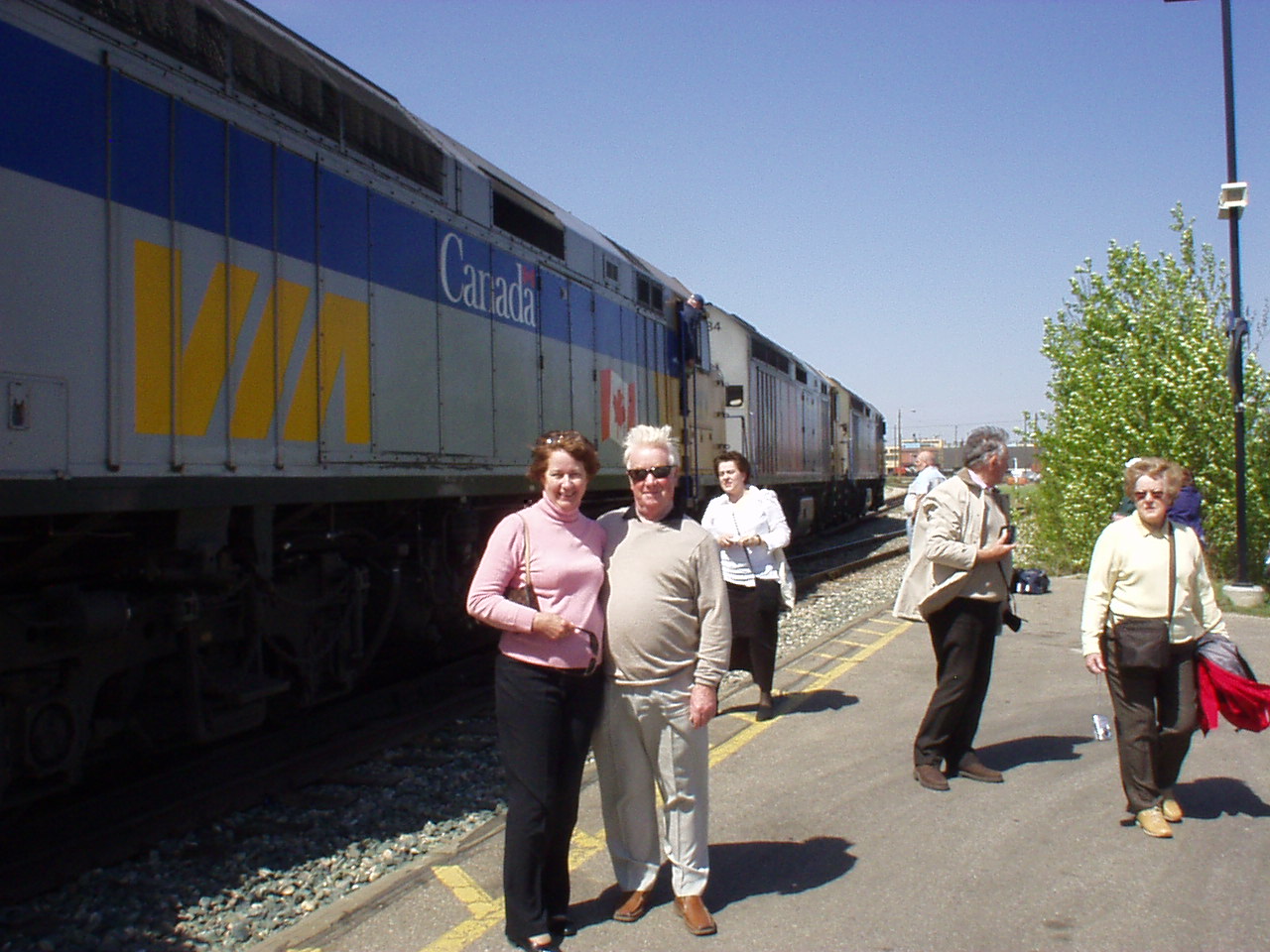
Ann & Michael
This picture has nothing much to do with anything!
Slow week on the census front this week, with nothing much happening. So I have been busy with C-PROP stuff - the new Cornish Parish Registers project. Over a quarter of a million records online and rising.
If anyone wants to drop me a line and tell me your woes or good news - please do so!
Rgds
Michael
The COCP and Birth place data
The guiding principle of the COCP is to transcribe “as is”. When applied to the place of birth data, this produces a slight problem. Many of the Cornish place names have a number of variations in spelling. St Hilary is a good example; there are about six different ways of spelling it and they can all come with or without the “St”. However, we are not conducting family history research; we are providing a tool for those people who are. They ought to be able to work out what the place name is on their own.
The book I often quote, by Edward Higgs, says that Cornwall is particularly prone to variations in place name spellings.
The enumerator’s instructions asked that from 1851 onwards, householders state the county and parish or town of birth. Frequently, the place named is a farm or other place, not a parish or town. Sometimes, even a street name or other address is given.
We just transcribe the enumerator’s words.
The enumeration instructions only required the county name for Irish or Scots. If, like me, you have Irish ancestors, this is particularly annoying. Its even worse when they just say Ireland or Scotland. For places like London, where all it says is London, this is treated as a county; just enter LND in the County field and a hyphen for place born.
Now for an innovation – a competition! There will be a prize for the volunteer who can explain to me why no one uses the Chapman codes for Irish Counties. It is not just the COCP volunteers, the Nth Wilts and Warwickshire ones are just the same. I am not sure what the prize will be for the best explanation – I’ll think of something.
The book I often quote, by Edward Higgs, says that Cornwall is particularly prone to variations in place name spellings.
The enumerator’s instructions asked that from 1851 onwards, householders state the county and parish or town of birth. Frequently, the place named is a farm or other place, not a parish or town. Sometimes, even a street name or other address is given.
We just transcribe the enumerator’s words.
The enumeration instructions only required the county name for Irish or Scots. If, like me, you have Irish ancestors, this is particularly annoying. Its even worse when they just say Ireland or Scotland. For places like London, where all it says is London, this is treated as a county; just enter LND in the County field and a hyphen for place born.
Now for an innovation – a competition! There will be a prize for the volunteer who can explain to me why no one uses the Chapman codes for Irish Counties. It is not just the COCP volunteers, the Nth Wilts and Warwickshire ones are just the same. I am not sure what the prize will be for the best explanation – I’ll think of something.
Tuesday, July 11, 2006
Census Birth Place Data
The quality of the birthplace data in the 1841 census is far from satisfactory. The household schedule contained two columns for this information headed ‘Whether born in the same county’ and ‘Whether born in Scotland, Ireland, or Foreign Parts’. Householders were instructed to write ‘yes’ or ‘no’ in the first column. In the second they were to write ‘Scotland’, ‘Ireland’ or ‘Foreigner’. The latter designation only referred to those born outside the UK who were not British subjects. Those born abroad who were British subjects were to be entered in the firsts column with the word ‘No’. The number of British subjects born outside the UK but resident there in 1841 cannot, therefore, be calculated. The enumerators were instructed to abbreviate these entries when copying them into their enumeration books, using ‘Y’, ‘N’, ‘S’, ‘I’ and ‘F” respectively.
In 1851 more informative answers were required. In the case of those born in England, householders were to indicate first the county, and then the town or parish of birth. This order was to be followed in all subsequent Victorian censuses. In the case of those born in Scotland, Ireland, the British Colonies, the East Indies or Foreign Parts, the country of birth was to be stated. The term ‘British Subject’ was to be added to the latter where appropriate. Interestingly, Wales was not mentioned in the instructions on this matter until 1891, when the principality was treated in the same manner as England. Presumably the Welsh had simply been overlooked, and this may affect the form of some entries. Some other minor changes were introduced in the course of the century. In 1861 a distinction was to be made between ‘British Subject’ and ‘naturalised British Subject’. In 1871 those born in Scotland, Ireland, the British Colonies or the East Indies were to state the country or colony of birth; and those born in Foreign Parts the particular state or country.
One may have doubts as to the extent to which householders understood the instructions with regard to those born outside the UK, but those relating to people born in England, Scotland and Ireland appear fairly straightforward. It may be something of a surprise therefore, to discover that the chief clerk of the GR in 1910 said:
“the birthplace tables were probably the most inaccurate of any of the Census Tables but feared they could not be dispensed with as some people seemed to attach considerable importance to the figures. Not only did a great many people not know in which county they were born but a place which was now a town might easily have been a small village at the time of the birth of persons aged 20 years and upwards who were enumerated in other towns.”
Occasionally the grasp of British geography shown by households and enumerators was not strong. However, the 19th century was a period of great re-organisation in local government, and some changes in the county of birth may reflect boundary changes. There was also a tendency to record the place of residence, or the earliest one which could be remembered, as the place of birth. In institutions such as workhouses there appears to be a propensity on the part of some returning officers to give the location of the institution as the place of birth.
Making Sense of the Census Revisited by Edward Higgs. Copyright TNA
In 1851 more informative answers were required. In the case of those born in England, householders were to indicate first the county, and then the town or parish of birth. This order was to be followed in all subsequent Victorian censuses. In the case of those born in Scotland, Ireland, the British Colonies, the East Indies or Foreign Parts, the country of birth was to be stated. The term ‘British Subject’ was to be added to the latter where appropriate. Interestingly, Wales was not mentioned in the instructions on this matter until 1891, when the principality was treated in the same manner as England. Presumably the Welsh had simply been overlooked, and this may affect the form of some entries. Some other minor changes were introduced in the course of the century. In 1861 a distinction was to be made between ‘British Subject’ and ‘naturalised British Subject’. In 1871 those born in Scotland, Ireland, the British Colonies or the East Indies were to state the country or colony of birth; and those born in Foreign Parts the particular state or country.
One may have doubts as to the extent to which householders understood the instructions with regard to those born outside the UK, but those relating to people born in England, Scotland and Ireland appear fairly straightforward. It may be something of a surprise therefore, to discover that the chief clerk of the GR in 1910 said:
“the birthplace tables were probably the most inaccurate of any of the Census Tables but feared they could not be dispensed with as some people seemed to attach considerable importance to the figures. Not only did a great many people not know in which county they were born but a place which was now a town might easily have been a small village at the time of the birth of persons aged 20 years and upwards who were enumerated in other towns.”
Occasionally the grasp of British geography shown by households and enumerators was not strong. However, the 19th century was a period of great re-organisation in local government, and some changes in the county of birth may reflect boundary changes. There was also a tendency to record the place of residence, or the earliest one which could be remembered, as the place of birth. In institutions such as workhouses there appears to be a propensity on the part of some returning officers to give the location of the institution as the place of birth.
Making Sense of the Census Revisited by Edward Higgs. Copyright TNA
Sunday, July 02, 2006
COCP Newsletter No 9
During June the COCP uploaded three 1861 pieces, ten 1871 & one 1881 piece. Well, it will have any moment now! Another 1861 piece is in the works, which means we are down to the last five pieces of the census out of 89.
There are about 20 parishes of the 1851 left to do, out of over 200. All are being worked on and could be finished soon. We are still recruiting people but are increasingly starting them off on checking rather than transcribing.
This year should see the completion of the 1851 & 61 projects and Rick is already working on the 1861 disc. We are really rolling on the 1871 and should complete that by the middle of next year. The 1881 is a big task, but we have a complete transcription already and if people are willing to move over to checking, it shouldn't take too long.
On the wider front, Free Census managed a rebuild on 24th June and the COCP now has 1,254,528 records online with them. One in seven of the records they have are the product of the COCP and its volunteers. If only the rest of them would get on with as we do!
The Warwickshire 1891 project is nearly complete. The penultimate piece is about to go online, leaving only one piece out of 122 to be completed. The North Wilts project is speeding up with the 4th piece completed and online on its own web site.
The Cornish OPC scheme has its online db up and running with over 200,000 records already uploaded. If any of you have parish register transcripts, why not send them in? 10 or 10,000, all are very welcome.
There are about 20 parishes of the 1851 left to do, out of over 200. All are being worked on and could be finished soon. We are still recruiting people but are increasingly starting them off on checking rather than transcribing.
This year should see the completion of the 1851 & 61 projects and Rick is already working on the 1861 disc. We are really rolling on the 1871 and should complete that by the middle of next year. The 1881 is a big task, but we have a complete transcription already and if people are willing to move over to checking, it shouldn't take too long.
On the wider front, Free Census managed a rebuild on 24th June and the COCP now has 1,254,528 records online with them. One in seven of the records they have are the product of the COCP and its volunteers. If only the rest of them would get on with as we do!
The Warwickshire 1891 project is nearly complete. The penultimate piece is about to go online, leaving only one piece out of 122 to be completed. The North Wilts project is speeding up with the 4th piece completed and online on its own web site.
The Cornish OPC scheme has its online db up and running with over 200,000 records already uploaded. If any of you have parish register transcripts, why not send them in? 10 or 10,000, all are very welcome.
Monday, June 05, 2006
COCP Newsletter No 8
Hello folks
The sun is shining in Cornwall! I should be gardening, but when I get up there I just sit and look at it all growing - weeds and plants!
While I have been away you have all been busy - three 1871 pieces and one 1861 have come in. They should all be online in a week or so.
Once a month, Rick produces stats for the COCP search engine. For May it never took less than 200 searches per day, and most well above that, several times hitting 400. This is a good indication of how much your work is being used - which of course, is the whole point.
The sister project of the COCP is C-PROP, the Online Parish Register Project. The database is now up and running and we have started to upload transcripts. At the moment we are trying to restrict use to the OPC scheme members, but I will keep you posted.
A subject that comes up quite often is the UK 2011 census returns. The National Archives have just said:
"The 1911 census is a huge document – more than 12 times the size of the 1901 census, with 35,000 volumes containing the details of our 35 million ancestors and occupying some 2 kilometres of shelving. They are in good condition and suitable for scanning, with less than 5 per cent requiring more extensive conservation work to be scanned safely.
By far the best option for providing access to the census is online delivery, making the returns available to the widest possible audience and preserving the integrity of the original records. Proposals are well underway to find the very best company to work with us in order to provide a good reliable service for millions of potential users. We have published our requirements in the Official Journal of the European Union and over the next couple of months will seek to create a shortlist of potential suppliers.
Learning from previous experience and building on our current plans, The National Archives is eagerly looking forward to launching the 1911 census online in January 2012."
These returns are the actual householder schedules; not enumerators' books. This is good news, because up to now rumour control has had it that this was mission impossible.
As this is so long, I will cut out the usual whinging! And just take the opportunity to thank you all again for all your support.
Onward and Upward!!!!!
The sun is shining in Cornwall! I should be gardening, but when I get up there I just sit and look at it all growing - weeds and plants!
While I have been away you have all been busy - three 1871 pieces and one 1861 have come in. They should all be online in a week or so.
Once a month, Rick produces stats for the COCP search engine. For May it never took less than 200 searches per day, and most well above that, several times hitting 400. This is a good indication of how much your work is being used - which of course, is the whole point.
The sister project of the COCP is C-PROP, the Online Parish Register Project. The database is now up and running and we have started to upload transcripts. At the moment we are trying to restrict use to the OPC scheme members, but I will keep you posted.
A subject that comes up quite often is the UK 2011 census returns. The National Archives have just said:
"The 1911 census is a huge document – more than 12 times the size of the 1901 census, with 35,000 volumes containing the details of our 35 million ancestors and occupying some 2 kilometres of shelving. They are in good condition and suitable for scanning, with less than 5 per cent requiring more extensive conservation work to be scanned safely.
By far the best option for providing access to the census is online delivery, making the returns available to the widest possible audience and preserving the integrity of the original records. Proposals are well underway to find the very best company to work with us in order to provide a good reliable service for millions of potential users. We have published our requirements in the Official Journal of the European Union and over the next couple of months will seek to create a shortlist of potential suppliers.
Learning from previous experience and building on our current plans, The National Archives is eagerly looking forward to launching the 1911 census online in January 2012."
These returns are the actual householder schedules; not enumerators' books. This is good news, because up to now rumour control has had it that this was mission impossible.
As this is so long, I will cut out the usual whinging! And just take the opportunity to thank you all again for all your support.
Onward and Upward!!!!!
Friday, May 26, 2006
Are your ancestors missing?
Regrettably the surviving census returns are not a full record of the population of nineteenth century England and Wales, and it may not always be possible to track down individuals, addresses and householdld These omissions reflect both under-enumeration at the time of the census, and subsequent loss or damage to the returns.
In the early censuses under the GRO, certain groups, usually those not living in conventional households, were simply not enumerated by name. These included the members of the Royal Navy on board ship in 1841, and possibly in 1851; all members of the merchant marine in 1841, and various sections of it thereafter, all fishermen afloat in 1841, and sections of this group thereafter; the crews of vessels engaged in inland navigation in 1841 and 1851; and all itinerants, travellers and night workers in 1841, and probably a considerable number of the same in later years. The soldiers serving abroad were never enumerated by name.
Undoubtedly, some individuals and households that should have been enumerated will have completely slipped through the census net. Some of these omissions might reflect clerical error as enumerators and households made inevitable slips in the recording or copying. A house might have been omitted, perhaps because it was unoccupied on census night, and the enumerator forgot to note it down as empty; a wife might have been absent because of an enumerator’s copying blunder; an elderly visitor might have been temporarily lost sight of; and so on. But in some districts, or among some social groups, it might have been difficult for hard-pressed enumerators to ensure that they had handed a household schedule to every family.
In the absence of any detailed research on the subject it is difficult to put a figure to such levels of under-enumeration. It should be noted, however, that post-enumeration surveys for the 1981 census indicated that 0.5% of households were missed in that census in the whole of England and Wales.
Some of the original returns, which were not always kept in optimum archival conditions in the nineteenth century, have been lost or damaged. Often such damage was confined to the backs and fronts of enumerators’ books, but more extensive gaps exist. Special returns, such as those for shipping, were often appended to the back of enumerators’ books, were especially liable to damage. In the 1851, all the ship returns seem to have been destroyed.
Making Sense of the Census Revisited by Edward Higgs. Copyright TNA
As far as the COCP knows, no large sections of the Cornish returns are missing, just odd pages here and there. Also, Cornwall was free of large urban districts, which are particularly hard to enumerate. However, the Cornish would have been heavily represented in the maritime returns that were not taken or which were lost in the earlier years.
In the early censuses under the GRO, certain groups, usually those not living in conventional households, were simply not enumerated by name. These included the members of the Royal Navy on board ship in 1841, and possibly in 1851; all members of the merchant marine in 1841, and various sections of it thereafter, all fishermen afloat in 1841, and sections of this group thereafter; the crews of vessels engaged in inland navigation in 1841 and 1851; and all itinerants, travellers and night workers in 1841, and probably a considerable number of the same in later years. The soldiers serving abroad were never enumerated by name.
Undoubtedly, some individuals and households that should have been enumerated will have completely slipped through the census net. Some of these omissions might reflect clerical error as enumerators and households made inevitable slips in the recording or copying. A house might have been omitted, perhaps because it was unoccupied on census night, and the enumerator forgot to note it down as empty; a wife might have been absent because of an enumerator’s copying blunder; an elderly visitor might have been temporarily lost sight of; and so on. But in some districts, or among some social groups, it might have been difficult for hard-pressed enumerators to ensure that they had handed a household schedule to every family.
In the absence of any detailed research on the subject it is difficult to put a figure to such levels of under-enumeration. It should be noted, however, that post-enumeration surveys for the 1981 census indicated that 0.5% of households were missed in that census in the whole of England and Wales.
Some of the original returns, which were not always kept in optimum archival conditions in the nineteenth century, have been lost or damaged. Often such damage was confined to the backs and fronts of enumerators’ books, but more extensive gaps exist. Special returns, such as those for shipping, were often appended to the back of enumerators’ books, were especially liable to damage. In the 1851, all the ship returns seem to have been destroyed.
Making Sense of the Census Revisited by Edward Higgs. Copyright TNA
As far as the COCP knows, no large sections of the Cornish returns are missing, just odd pages here and there. Also, Cornwall was free of large urban districts, which are particularly hard to enumerate. However, the Cornish would have been heavily represented in the maritime returns that were not taken or which were lost in the earlier years.
Thursday, May 25, 2006
COCP Newsletter No 7
Hello folks
There are only 8 out of 89 pieces left of the 1861 and about two dozen parishes out of the over 200 parishes that make up the 1851. Should finish both before the end of the year.
We have just completed another 4 pieces of the 1871, which means we have done over 30% of that one. And the 1871 is my main topic today.
When we started the 1871 we were in the habit of sending multi-piece discs to transcribers. Obviously, we hoped you would do more than one, but it also saved on our considerable postal costs. It costs me about £2 for an overseas disc and £1 for a UK one. (these figures include the disc, packaging etc). I am not whinging about this - after all I am a volunteer!
We turn no one away, so we have a steadily increasing number of volunteers. So we are re-allocating pieces from multiple-piece discs. We try and keep everyone posted, but rely on you reading the emails!
We are also trying to persuade some people to try their hand at checking. This will continue to be a feature of grovelling emails from me! The next big task for us is the 1881. We are fortunate in having a complete transcription of the 1881 (don't ask). But it has to be reformatted for Free Census purposes and then checked. So we will end up needing to persuade you all to switch to checking for the final push.
I would like all 1871 TRANSCRIBERS to check in with myself or Kay; please give the piece number you are working on and a rough estimate of your progress.
There are only 8 out of 89 pieces left of the 1861 and about two dozen parishes out of the over 200 parishes that make up the 1851. Should finish both before the end of the year.
We have just completed another 4 pieces of the 1871, which means we have done over 30% of that one. And the 1871 is my main topic today.
When we started the 1871 we were in the habit of sending multi-piece discs to transcribers. Obviously, we hoped you would do more than one, but it also saved on our considerable postal costs. It costs me about £2 for an overseas disc and £1 for a UK one. (these figures include the disc, packaging etc). I am not whinging about this - after all I am a volunteer!
We turn no one away, so we have a steadily increasing number of volunteers. So we are re-allocating pieces from multiple-piece discs. We try and keep everyone posted, but rely on you reading the emails!
We are also trying to persuade some people to try their hand at checking. This will continue to be a feature of grovelling emails from me! The next big task for us is the 1881. We are fortunate in having a complete transcription of the 1881 (don't ask). But it has to be reformatted for Free Census purposes and then checked. So we will end up needing to persuade you all to switch to checking for the final push.
I would like all 1871 TRANSCRIBERS to check in with myself or Kay; please give the piece number you are working on and a rough estimate of your progress.
Saturday, May 06, 2006
Cornish Online Research
If you are a newcomer to online family history research in Cornwall, then your first port of call should be to the Cornish pages of GENUKI (xhttp://www.genuki.org.uk/big/eng/Cornwall/). Not only is there a lot of information about the county in general terms, but each parish has its own pages. These pages also contain useful information, but perhaps more importantly, they all contain many links to other Cornish web sites. In particular to the Census Project and the OPC scheme.
The OPC (Online Parish Clerk) scheme was started in Cornwall about 5 years ago and has since spread to 8 or 9 other English counties. It could be called the “adopt-a-parish” scheme, but OPC sounded more interesting. Public spirited people step forward and adopt a parish or parishes. Their aim is to provide information and advice to anyone who contacts them. Some of them have their own web sites and some of them contain transcribed data, things such as parish registers. Others have their data hosted on other web sites and the scheme has its own web site (http://www.cornwall-opc.org/) which contains details of Cornish parishes and of the OPC themselves.
The OPC scheme is about to launch itself into a new project – C-PROP. This is the Cornish Parish Register Online Project and aims to get all 5 million Cornish parish register entries online free-to-view in a searchable database.
The Cornwall Online Census Project (COCP) is a sort of semi-detached part of the Free Census project. The COCP is busy transcribing ALL the Cornish 19th century census returns and placing them online. They are available on the Free Census OLDB (http://www.freecen.org.uk/) and on the COCP web site (http://freepages.genealogy.rootsweb.com/~kayhin/ukocp.html). The whole of the 1841 & 1891 are online plus most of the 51 & 61. The 1871 & 81 are also appearing.
There are of course, lots of Cornish web sites you might find helpful. West Penwith is perhaps the best (http://west-penwith.org.uk/), but there are lots of others, including St Keverne (http://www.st-keverne.com/).
Finally, there are the commercial sites, the national projects (FreeBMD for instance) and the Cornish Family History web site. I cannot speak for them, but you can easily find them via Google.
The OPC (Online Parish Clerk) scheme was started in Cornwall about 5 years ago and has since spread to 8 or 9 other English counties. It could be called the “adopt-a-parish” scheme, but OPC sounded more interesting. Public spirited people step forward and adopt a parish or parishes. Their aim is to provide information and advice to anyone who contacts them. Some of them have their own web sites and some of them contain transcribed data, things such as parish registers. Others have their data hosted on other web sites and the scheme has its own web site (http://www.cornwall-opc.org/) which contains details of Cornish parishes and of the OPC themselves.
The OPC scheme is about to launch itself into a new project – C-PROP. This is the Cornish Parish Register Online Project and aims to get all 5 million Cornish parish register entries online free-to-view in a searchable database.
The Cornwall Online Census Project (COCP) is a sort of semi-detached part of the Free Census project. The COCP is busy transcribing ALL the Cornish 19th century census returns and placing them online. They are available on the Free Census OLDB (http://www.freecen.org.uk/) and on the COCP web site (http://freepages.genealogy.rootsweb.com/~kayhin/ukocp.html). The whole of the 1841 & 1891 are online plus most of the 51 & 61. The 1871 & 81 are also appearing.
There are of course, lots of Cornish web sites you might find helpful. West Penwith is perhaps the best (http://west-penwith.org.uk/), but there are lots of others, including St Keverne (http://www.st-keverne.com/).
Finally, there are the commercial sites, the national projects (FreeBMD for instance) and the Cornish Family History web site. I cannot speak for them, but you can easily find them via Google.
Subscribe to:
Posts (Atom)