Here in Cornwall, we are always looking for new ways of doing things. We are also very conscious of the past - we are sort of moving forward into the past.
Until about 1850, there was a treadmill in Bodmin Gaol; there were other gaols in the county that also had them. Criminals would be sent there for a few weeks to while away their days turning a treadmill. Usually, this was for minor offences such as being drunk and disorderly. This was in the days of course, when you could be hung for stealing a sheep, or even worse, sent to Australia!
We have just as much disorderly behavour on our streets now as we did then, perhaps more. In 1850 there were very few people from England taking their holidays here. If any.
So, the authorities have decided to re-introduce the treadmill. It has two main advantages as a punishment. It is cheap. Criminals will live at home; have to make their own way to the treadmill and bring their own food and drink. The treadmills will be linked to banks of batteries that will provide power for the lights and for boiling the kettle for the supervisors.
In the 19th century, the treadmills were used to grind flour and this week a deal has been struck with a well known organic biscuit maker. His name is a commercial secret but think feathers..... Just imagine, not only organic, but hand-ground flour. Well, foot-ground anyway.
Of course, there might be people who get in the wheel and refuse to walk. A small amount of electrical power will get the wheel moving, when it will become very uncomfortable to refuse to walk.
In fact, I say walk, but many people will be running. The person who completes the most miles in each day will get one day knocked off their sentence! Of course, there will some sort of handicapping system so that little old men will have a chance.
The first bank of wheels will be in a well known seaside resort and it is hoped that the building will incorporate a viewing gallery, entry to which will incur a small charge.
Thursday, November 16, 2006

Saturday, November 11, 2006
NWOCP Newsletter No 3
Hello Folks
I have been a little remiss with these newsletters just lately. Partly summer visitors, partly computer problems (self inflicted) and partly biting off more than I could chew.
However, things are rolling along and we have recruited several new people, including one this morning. Some people have completed their task and left; others have dropped out for various reasons.
1861. We have 22 pieces to do; 4 are online; 2 are being checked; another 4 are waiting for a checker to appear and the rest are with transcribers.
1871. 32 pieces to do; 6 online; 7 being checked; another 5 transcribed and waiting for a checker; the rest are all with transcribers.
1841. 12 Hundreds to do. All are being worked on and 5 have some parishes complete and online. The 1841 is being done and uploaded by parish. One Hundred is nearly finished, when I shall stitch the parishes together and upload it to Free Census.
1891. 4 pieces online; one being transcribed. There is another piece partly transcribed. The transcribers for this were an Australian couple who have worked for me on the Warwickshire project for six years. Dick was diagnosed with cancer and died in less than two months. A real blow to me, even though I had never met him.
Don't forget to visit my blog on http://medeschole.blogspot.com/ now and again. Although it is called Cornish Census Returns, much of it is equally applicable to our project. This will be posted on it this morning.
And of course, you could check out our own web site - have a gloat!
I would like to take this opportunity to thank you all for your support. Keep them coming!
Rgds
Michael
Organiser, Nth Wilts Online Census Project
http://www.pope-genealogy.me.uk/nwocp.htm
I have been a little remiss with these newsletters just lately. Partly summer visitors, partly computer problems (self inflicted) and partly biting off more than I could chew.
However, things are rolling along and we have recruited several new people, including one this morning. Some people have completed their task and left; others have dropped out for various reasons.
1861. We have 22 pieces to do; 4 are online; 2 are being checked; another 4 are waiting for a checker to appear and the rest are with transcribers.
1871. 32 pieces to do; 6 online; 7 being checked; another 5 transcribed and waiting for a checker; the rest are all with transcribers.
1841. 12 Hundreds to do. All are being worked on and 5 have some parishes complete and online. The 1841 is being done and uploaded by parish. One Hundred is nearly finished, when I shall stitch the parishes together and upload it to Free Census.
1891. 4 pieces online; one being transcribed. There is another piece partly transcribed. The transcribers for this were an Australian couple who have worked for me on the Warwickshire project for six years. Dick was diagnosed with cancer and died in less than two months. A real blow to me, even though I had never met him.
Don't forget to visit my blog on http://medeschole.blogspot.com/ now and again. Although it is called Cornish Census Returns, much of it is equally applicable to our project. This will be posted on it this morning.
And of course, you could check out our own web site - have a gloat!
I would like to take this opportunity to thank you all for your support. Keep them coming!
Rgds
Michael
Organiser, Nth Wilts Online Census Project
http://www.pope-genealogy.me.uk/nwocp.htm
Sunday, November 05, 2006
British early census returns
The arrangements for the taking of a decennial census were set out in a Parliamentary act in 1800, but there had been discussions on the necessity of taking a census for many years. At the time of the first census, in 1801, the country was at war. We had had several bad harvests and maritime conditions were unstable. Many of the agricultural workers were in the Army or at sea. The government needed to find out how many people lived in Britain, what they were doing and where they were doing it.
The first census consisted of six questions. The first 3 were to be answered by house-to-house enquiry on 10 March 1801, or as soon as possible after that date. These questions established how many dwellings, how many people and what occupations they had.
The next two questions were addressed to the local clergy asking how many baptisms, burials & marriages had taken place. These covered the period back to 1700 in the case of baptisms and burials and back to 1754 for marriages.
The final question just asked if there was anything else the respondents would like to say.
The government sent out printed forms and the whole exercise was supervised by the Overseers of the Poor or “other substantial householders”.
The results consisted of numerical totals and did not include names. However, some local returns still survive giving names. The returns were affirmed before local Justices of the Peace by a certain date. They then went up the chain to the Home Office in London. The answers given by the clergy followed a different route and ended up with the Privy Council.
In 1811, the census asked the same questions, but with knobs on. It distinguished between uninhabited & building dwellings. The question about occupation was also amended. The clergy were asked to record the numbers of baptisms, marriages and burials registered in each of the ten years since the last census.
In 1821, additional questions were asked about the ages of the people. These were grouped in five year bands up to 20 & in 10 year bands after that.
In 1831 more extensive questions about occupations were asked. There were seven categories. Agricultural, manufacturing, retail or handicraft, capitalists, mines & fishermen, retired or disabled and finally, those employed as servants.
In addition, the clergy were asked to indicate the number of illegitimate children born in 1830.
In 1841 changes were made that are, in essence, still with us today. The returns included, for the first time, the names of the respondents. The carrying out of the census was handed over to the General Registration Office and the census was organised on tbe basis of the new poor law administrative districts.
The story of the British censuse is one of gradual change. It is also a story of a struggle between those who wanted to keep it simple (Home Office, GRO etc) and those who wanted to ask as many questions as possible. These latter including various scientific and social institutions as well as government departments. This struggle continues, as could be seen in the UK press last week.
The first census consisted of six questions. The first 3 were to be answered by house-to-house enquiry on 10 March 1801, or as soon as possible after that date. These questions established how many dwellings, how many people and what occupations they had.
The next two questions were addressed to the local clergy asking how many baptisms, burials & marriages had taken place. These covered the period back to 1700 in the case of baptisms and burials and back to 1754 for marriages.
The final question just asked if there was anything else the respondents would like to say.
The government sent out printed forms and the whole exercise was supervised by the Overseers of the Poor or “other substantial householders”.
The results consisted of numerical totals and did not include names. However, some local returns still survive giving names. The returns were affirmed before local Justices of the Peace by a certain date. They then went up the chain to the Home Office in London. The answers given by the clergy followed a different route and ended up with the Privy Council.
In 1811, the census asked the same questions, but with knobs on. It distinguished between uninhabited & building dwellings. The question about occupation was also amended. The clergy were asked to record the numbers of baptisms, marriages and burials registered in each of the ten years since the last census.
In 1821, additional questions were asked about the ages of the people. These were grouped in five year bands up to 20 & in 10 year bands after that.
In 1831 more extensive questions about occupations were asked. There were seven categories. Agricultural, manufacturing, retail or handicraft, capitalists, mines & fishermen, retired or disabled and finally, those employed as servants.
In addition, the clergy were asked to indicate the number of illegitimate children born in 1830.
In 1841 changes were made that are, in essence, still with us today. The returns included, for the first time, the names of the respondents. The carrying out of the census was handed over to the General Registration Office and the census was organised on tbe basis of the new poor law administrative districts.
The story of the British censuse is one of gradual change. It is also a story of a struggle between those who wanted to keep it simple (Home Office, GRO etc) and those who wanted to ask as many questions as possible. These latter including various scientific and social institutions as well as government departments. This struggle continues, as could be seen in the UK press last week.
Wednesday, November 01, 2006
Free Census checking software
Yet another volunteer checker struggling to get the checking software to work! We have repeatedly asked Free Census to sort it out but its like talking to a rather dim brick wall.
Here is a simplified way to do it:
Download WINCC
Save to desktop
Double click on icon
Unzip into c:\wincc. This folder will be the one suggested by WINCC. Say yes to creating a shortcut, it will take you to Windows Explorer. Drag the shortcut icon to your desktop.
Open WINCC & follow the instructions. Enter personal details - 4-digit code, first two letters of surname & first two letters of forename.
WINCC will then want to test the external drive. Normally it would expect to use the A drive, the floppy drive. If you don't have one, but you do have other removable media drives, WINCC will say it has detected more than one removable drive. Removable in the sense that you can put media in yourself.
Select one of these, but you must have something in the drive. Perhaps the best option is to plug your digital camera in and try selecting that drive. You must restart WINCC after plugging the camera in.
If you don't have any removable drives, then WINCC will just ignore the test requirement.
Once WINCC has a drive, it will create a small TEST directory. You can open this and play with it.
When you open WINCC you get the first record overlaid with the first household panel. You must tab through all fields on this household panel to get to the first record. You must check as you tab on both types of record. The second field is Ecclesiastical parish. If there isn't one, then enter a hyphen.
Don't spend a lot of time with the TEST directory, import the data zip under Options and try it out. You can import from the floppy drive A, or there is a folder in WINCC called ZIP. Copy the still zipped data file to that folder and import from there.
Remember that you can re-install WINCC and re-import the data file if things go wrong.
Pay particular attention to the BROWSE button; it will allow you to insert records, split households ect. Right clicking on the BROWSE screen brings up help.
Here is a simplified way to do it:
Download WINCC
Save to desktop
Double click on icon
Unzip into c:\wincc. This folder will be the one suggested by WINCC. Say yes to creating a shortcut, it will take you to Windows Explorer. Drag the shortcut icon to your desktop.
Open WINCC & follow the instructions. Enter personal details - 4-digit code, first two letters of surname & first two letters of forename.
WINCC will then want to test the external drive. Normally it would expect to use the A drive, the floppy drive. If you don't have one, but you do have other removable media drives, WINCC will say it has detected more than one removable drive. Removable in the sense that you can put media in yourself.
Select one of these, but you must have something in the drive. Perhaps the best option is to plug your digital camera in and try selecting that drive. You must restart WINCC after plugging the camera in.
If you don't have any removable drives, then WINCC will just ignore the test requirement.
Once WINCC has a drive, it will create a small TEST directory. You can open this and play with it.
When you open WINCC you get the first record overlaid with the first household panel. You must tab through all fields on this household panel to get to the first record. You must check as you tab on both types of record. The second field is Ecclesiastical parish. If there isn't one, then enter a hyphen.
Don't spend a lot of time with the TEST directory, import the data zip under Options and try it out. You can import from the floppy drive A, or there is a folder in WINCC called ZIP. Copy the still zipped data file to that folder and import from there.
Remember that you can re-install WINCC and re-import the data file if things go wrong.
Pay particular attention to the BROWSE button; it will allow you to insert records, split households ect. Right clicking on the BROWSE screen brings up help.
Saturday, October 21, 2006
This week in Cornwall
Quite an exciting week in Cornwall!
On Thursday there was an earthquake roughly along the valley of the river Tamar. Cornwall is now an island! Associated with this on Thursday evening, a tidal wave swept in at Hayle – and West Penwith is also an island.
Temporary bridges will be placed over the Tamar chasm at the main former crossing points. There will a toll on traffic entering Cornwall with the money being used to reduce Council Taxes. Council Tax payers will be exempt from these charges. The King Harry ferry will serve West Penwith till we can afford a bridge.
A new swinging tax on holiday homes will be introduced next Wednesday. The money raised this way will be used to reduce Council Taxes.
The NHS institutions in Cornwall are to be controlled by a new governing body. Membership will be restricted to Council Tax payers and they will be elected by Council Tax payers.
Institutions of Higher Learning in Cornwall will be grouped together, although on dispersed sites, and will become the University of Cornwall. The Universities of Exeter & Plymouth will be told to mind their own business.
In future, anybody living full time in Cornwall and paying Council Tax will be entitled to claim they are Cornish. The rest will be known as “the English”.
Anybody suggesting that road signs etc should be bi-lingual will be asked to sign a legally binding form that commits them to paying for the changes.
The new French toxic waste plant will be moved to England. We shall use our rubbish to enlarge the Scillies.
On Thursday there was an earthquake roughly along the valley of the river Tamar. Cornwall is now an island! Associated with this on Thursday evening, a tidal wave swept in at Hayle – and West Penwith is also an island.
Temporary bridges will be placed over the Tamar chasm at the main former crossing points. There will a toll on traffic entering Cornwall with the money being used to reduce Council Taxes. Council Tax payers will be exempt from these charges. The King Harry ferry will serve West Penwith till we can afford a bridge.
A new swinging tax on holiday homes will be introduced next Wednesday. The money raised this way will be used to reduce Council Taxes.
The NHS institutions in Cornwall are to be controlled by a new governing body. Membership will be restricted to Council Tax payers and they will be elected by Council Tax payers.
Institutions of Higher Learning in Cornwall will be grouped together, although on dispersed sites, and will become the University of Cornwall. The Universities of Exeter & Plymouth will be told to mind their own business.
In future, anybody living full time in Cornwall and paying Council Tax will be entitled to claim they are Cornish. The rest will be known as “the English”.
Anybody suggesting that road signs etc should be bi-lingual will be asked to sign a legally binding form that commits them to paying for the changes.
The new French toxic waste plant will be moved to England. We shall use our rubbish to enlarge the Scillies.
Wednesday, October 18, 2006
COCP Newsletter No 16
Hello folks
Sun is out in Cornwall; off up the garden for a cup of coffee and a cigar. Might even do some gardening.
If you imagine the COCP as an inverted triangle, we have transcribers at the top, forming the base, then checkers in the middle, then, right at the bottom, me. All pieces are validated by me. I like it this way, although it means a lot of work, because it gives me control of the project and allows the imposition of a certain style. If something is wrong, I can ensure that it's like that on all the returns - wrong that is!
There are two aspects to the errors I see. Firstly, there are some rather depressing repetitious ones. Irish county Chapman codes for instance. Secondly, there is the sheer ingenuity displayed by many volunteers, in inventing new problems. Congratulations!
I am just doing a Truro piece. There is a Mr James who is a Coal Merchant. Next door is another Mr James. This gentleman is a Cod Merchant. It certainly looks like Cod, but neither the transcriber or checker have flagged it up, so presumably they thought that in 19th century Truro it would be likely there was a Cod Merchant. Seems a bit specialised to me, so I changed it to Coal. In fact, the letter "d" often looks like "ol" or "al".
I might be wrong of course; if anyone knows of other Cod Merchants, let me know.
What other things have attracted my attention? If you want to put RN in the occupation field, please put a space between the R & the N, otherwise you'll upset the Fishheads by getting Rn.
Don't put in unnecessary notes. If you are unsure of a surname, a note on the head's record is good enough. I have to delete or edit all these notes.
Don't put in unnecessary flags. If there is no place of birth; then people are correctly entering UNK hyphen and then spoiling it by flagging it up.
Do use Google. I have just decoded a place name in Devon. The transcriber & checker quite rightly had it as Whitechurch Csquiggle. It is probably Whitechurch (or Whitchurch) Canonicorum. Google knew.
After validation it goes to Rick Parsons for post-validation. This is to remove all the errors that have survived the 3-stage process; a surprising number. He has asked me to point out to checkers that they are responsible for entering the Ecclesiastical Parish name. You must look at the top right hand entry on each page. Quite often, they change during a piece. If there isn't one, then enter a hyphen.
Finally (thank goodness you say!), please do drop me a line telling me how you are getting on. I hate it when I find out that someone has volunteered to do something but in fact, they have decided not to bother. I had someone the other day who thought I would have picked it up from the mailing list that he was off on his holidays and had therefore decided not to do any transcription!
Enough whinging. We are doing well; the end of the 1861 is in sight, followed by the 1851. Free Census has 8.5 million records online and 15% or more of those are ours. Congratulations to you all!
I apologise for the length of this!
Sun is out in Cornwall; off up the garden for a cup of coffee and a cigar. Might even do some gardening.
If you imagine the COCP as an inverted triangle, we have transcribers at the top, forming the base, then checkers in the middle, then, right at the bottom, me. All pieces are validated by me. I like it this way, although it means a lot of work, because it gives me control of the project and allows the imposition of a certain style. If something is wrong, I can ensure that it's like that on all the returns - wrong that is!
There are two aspects to the errors I see. Firstly, there are some rather depressing repetitious ones. Irish county Chapman codes for instance. Secondly, there is the sheer ingenuity displayed by many volunteers, in inventing new problems. Congratulations!
I am just doing a Truro piece. There is a Mr James who is a Coal Merchant. Next door is another Mr James. This gentleman is a Cod Merchant. It certainly looks like Cod, but neither the transcriber or checker have flagged it up, so presumably they thought that in 19th century Truro it would be likely there was a Cod Merchant. Seems a bit specialised to me, so I changed it to Coal. In fact, the letter "d" often looks like "ol" or "al".
I might be wrong of course; if anyone knows of other Cod Merchants, let me know.
What other things have attracted my attention? If you want to put RN in the occupation field, please put a space between the R & the N, otherwise you'll upset the Fishheads by getting Rn.
Don't put in unnecessary notes. If you are unsure of a surname, a note on the head's record is good enough. I have to delete or edit all these notes.
Don't put in unnecessary flags. If there is no place of birth; then people are correctly entering UNK hyphen and then spoiling it by flagging it up.
Do use Google. I have just decoded a place name in Devon. The transcriber & checker quite rightly had it as Whitechurch Csquiggle. It is probably Whitechurch (or Whitchurch) Canonicorum. Google knew.
After validation it goes to Rick Parsons for post-validation. This is to remove all the errors that have survived the 3-stage process; a surprising number. He has asked me to point out to checkers that they are responsible for entering the Ecclesiastical Parish name. You must look at the top right hand entry on each page. Quite often, they change during a piece. If there isn't one, then enter a hyphen.
Finally (thank goodness you say!), please do drop me a line telling me how you are getting on. I hate it when I find out that someone has volunteered to do something but in fact, they have decided not to bother. I had someone the other day who thought I would have picked it up from the mailing list that he was off on his holidays and had therefore decided not to do any transcription!
Enough whinging. We are doing well; the end of the 1861 is in sight, followed by the 1851. Free Census has 8.5 million records online and 15% or more of those are ours. Congratulations to you all!
I apologise for the length of this!
Sunday, October 01, 2006
Newsletter No 15
Hello folks
Free Census rebuilt their database on 11th October. We have:
Cornwall 1841 340901
Cornwall 1851 235008
Cornwall 1861 337103
Cornwall 1871 126063
Cornwall 1881 35116
Cornwall 1891 318637
Cornish total 1392828
This is 16.5% of the total FC upload of 8,454,662 returns.
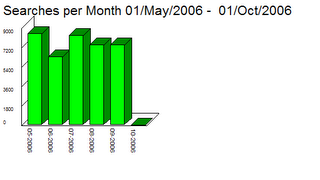
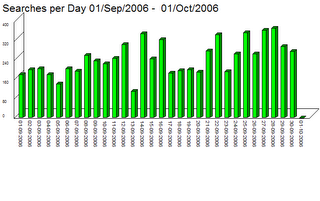
As you will all know, we also have a search engine on the COCP web site. Here are the some of the stats for September.
Free Census rebuilt their database on 11th October. We have:
Cornwall 1841 340901
Cornwall 1851 235008
Cornwall 1861 337103
Cornwall 1871 126063
Cornwall 1881 35116
Cornwall 1891 318637
Cornish total 1392828
This is 16.5% of the total FC upload of 8,454,662 returns.
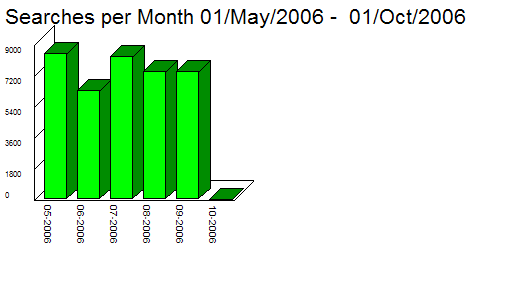
As you will all know, we also have a search engine on the COCP web site. Here are the some of the stats for September.

Saturday, September 30, 2006
Warwickshire Farewell
It is six years since, encouraged by the easy start-up of the Cornish 1891 project, I decided to run a similar project for the Warwickshire 1891 returns. At first, the project only covered the districts of Aston and Birmingham, because all my ancestral lines lived in Aston from 1845 onwards. But gradually, the project grew till it covered the whole of Warwickshire – 122 “pieces” that eventually produced about 780,000 records.
Each record has been transcribed, checked, validated and generally buffed up; finally being uploaded to Free Census and to the Warwickshire web site run by Pickard Trepess. Each piece was produced from a 3 or 4 fiche set, loaned to me by the Church of Latter-Day Saints of Jesus Christ – the LDS or Mormons. Transcribers, living anywhere from Hong Kong to Vancouver via Australia and New Zealand, transcribed the contents of the fiche set to produce a data file that was then sent to a checker. The checkers worked their way through the data, identifying and fixing errors. Finally, I validated the work, ending up with a data file for uploading to Free Census. This file also went to Pickard to convert to html for his web pages.
About 150 people worked on the project and a list will be published shortly. I would like to particularly mention Jeanagh Punter, who for several years worked as the project recruiter and Pickard, who not only produces the html files and hosts the web site, but for the early years was an invaluable help with “technical” issues. I do have another list, luckily a lot shorter, of those people who vanished with the microfiche set. I won’t publish that. An even sadder list is of the five people who died “in harness”; one of them only a couple of weeks ago. This last one, an Australian, had worked on the project from the very beginning. I owe him, and all the other the other volunteers, a great debt.
What now? First I shall cut a disc containing the data and send it to the Mormons, The National Archives and the Archive of Historical Data at the University of Essex. I might also send a copy to the various societies engaged in Warwickshire family history; although none of them have ever shown the slightest interest in the project. Then I shall settle down to a slow steady review of the lot – to try and eliminate some of the uncertainties and to incorporate the corrections that kind people have emailed in.
I am not going to do any more Warwickshire census returns, but I wish the organiser of the 1861 project all the best and hope that someone somewhere will be encouraged enough by my words to start up the 1871 project! Better than watching television!
Each record has been transcribed, checked, validated and generally buffed up; finally being uploaded to Free Census and to the Warwickshire web site run by Pickard Trepess. Each piece was produced from a 3 or 4 fiche set, loaned to me by the Church of Latter-Day Saints of Jesus Christ – the LDS or Mormons. Transcribers, living anywhere from Hong Kong to Vancouver via Australia and New Zealand, transcribed the contents of the fiche set to produce a data file that was then sent to a checker. The checkers worked their way through the data, identifying and fixing errors. Finally, I validated the work, ending up with a data file for uploading to Free Census. This file also went to Pickard to convert to html for his web pages.
About 150 people worked on the project and a list will be published shortly. I would like to particularly mention Jeanagh Punter, who for several years worked as the project recruiter and Pickard, who not only produces the html files and hosts the web site, but for the early years was an invaluable help with “technical” issues. I do have another list, luckily a lot shorter, of those people who vanished with the microfiche set. I won’t publish that. An even sadder list is of the five people who died “in harness”; one of them only a couple of weeks ago. This last one, an Australian, had worked on the project from the very beginning. I owe him, and all the other the other volunteers, a great debt.
What now? First I shall cut a disc containing the data and send it to the Mormons, The National Archives and the Archive of Historical Data at the University of Essex. I might also send a copy to the various societies engaged in Warwickshire family history; although none of them have ever shown the slightest interest in the project. Then I shall settle down to a slow steady review of the lot – to try and eliminate some of the uncertainties and to incorporate the corrections that kind people have emailed in.
I am not going to do any more Warwickshire census returns, but I wish the organiser of the 1861 project all the best and hope that someone somewhere will be encouraged enough by my words to start up the 1871 project! Better than watching television!
Friday, September 29, 2006
Public Relations No 3
The Cornwall online Census Project aims to transcribe all the Cornish 19th century census returns and make them accessible online free of charge. You’ll find the complete 1841 and 1891 censuses for Cornwall already online at http://freepages.genealogy.rootsweb.com/~kayhin/ukocp.html as is 83 per cent of the 1851 census, 96 per cent of the 1861, 35 per cent of the 1871, and seven per cent of the 1881. There area also three pieces (donated and unchecked) for the 1901 census.
Most of the transcribed records are also available at http://www.freecen.org.uk/ – the Free Census Project site.
The Online Parish Clerk scheme began in Cornwall about five years ago and has spread to Cumberland & Westmorland, Devon, Dorset, Kent, Lancashire, Sussex, Warwickshire and Wiltshire. Volunteers adopt one or more parishes and collect family history information about the parishes, offering free ‘look-ups’ for researchers.
You can now search a combined database at http://www.cornwall-opc-database.org/ which contains around 330,000 records from the Cornish OPCs. At present, the information is mainly from Church of England parish registers, but Nonconformist registers and other records are expected to be included in the future.
Four volunteers are currently transcribing births, marriages and deaths from the 19th century West Briton and Cornwall Advertiser newspaper, plus court cases. Go to http://freepages.genealogy.rootsweb.com/~wbritonad/cornwall/intro.html to view the transcripts.
Most of the transcribed records are also available at http://www.freecen.org.uk/ – the Free Census Project site.
The Online Parish Clerk scheme began in Cornwall about five years ago and has spread to Cumberland & Westmorland, Devon, Dorset, Kent, Lancashire, Sussex, Warwickshire and Wiltshire. Volunteers adopt one or more parishes and collect family history information about the parishes, offering free ‘look-ups’ for researchers.
You can now search a combined database at http://www.cornwall-opc-database.org/ which contains around 330,000 records from the Cornish OPCs. At present, the information is mainly from Church of England parish registers, but Nonconformist registers and other records are expected to be included in the future.
Four volunteers are currently transcribing births, marriages and deaths from the 19th century West Briton and Cornwall Advertiser newspaper, plus court cases. Go to http://freepages.genealogy.rootsweb.com/~wbritonad/cornwall/intro.html to view the transcripts.
[Published in the October 2006 edition of Practical Family History magazine]
Public Relations No 2
Cornwall is an unusual English county, not least because many people will tell you that it is not English or a county! It is also unusual in that it is further advanced towards becoming fully online, as far as family history research is concerned. As the organiser of the Cornwall Online Census project I thought I would let other readers know what online resources are available to Cornish researchers.
At the centre of Cornish online research are the Cornish GENUKI pages (http://www.genuki.org.uk/big/eng/Cornwall/). These provide links to anything and everything to do with Cornish family history. The pages are organised on a hierarchical basis and lead to some 260 town and parish pages and some more general pages. Normally GENUKI aims to use the county and parishes as they were in 1850 but these Cornish pages also include new parishes created towards the end of the 19th century. The Cornish GENUKI pages are constantly being updated, so it is worth checking them frequently.
We started the Cornwall Online Census Project in the summer of 2000, transcribing the 1891 returns from fiche supplied by the LDS. Within 18 months the first returns were online having gone through the process of transcription, checking and validation. By 1st July this year the 1841 and 1891 censuses were complete along with 90 per cent of the 1851 & 1861; 40 per cent of the 1871; and ten per cent of the 1881). The aim of the project is to transcribe all the Cornish 19th census returns and place them online free-to-view at http://freepages.genealogy.rootsweb.com/~kayhin/ukocp.html.
We also have an online parish clerk scheme, which started in Cornwall about four years ago and has now spread to half a dozen other counties. Volunteers adopt a parish or parishes and seek to accumulate information and data about their parish. Their primary aim is to offer free “look ups” for researchers, using via the Cornish mailing lists. The OPC scheme has now launched its own searchable online “free-to-view” database (http://www.cornwall-opc-database.org/). Starting just over a month ago it already has over a quarter of a million records online. At present it is concentrating on Church of England registers, but its scope will expand to cover non-conformist registers and other types of data (burials for example).
There are two Cornish mailing lists. The main Cornish list, Cornish-L, is for all things Cornish, while Cornish-GEN is a list strictly for family history. The Cornish-L list is home to the famous (or infamous) virtual Christmas party! Details of how to subscribe can be found at Rootsweb.
[published in November 2006 edition of Family History Monthly]
At the centre of Cornish online research are the Cornish GENUKI pages (http://www.genuki.org.uk/big/eng/Cornwall/). These provide links to anything and everything to do with Cornish family history. The pages are organised on a hierarchical basis and lead to some 260 town and parish pages and some more general pages. Normally GENUKI aims to use the county and parishes as they were in 1850 but these Cornish pages also include new parishes created towards the end of the 19th century. The Cornish GENUKI pages are constantly being updated, so it is worth checking them frequently.
We started the Cornwall Online Census Project in the summer of 2000, transcribing the 1891 returns from fiche supplied by the LDS. Within 18 months the first returns were online having gone through the process of transcription, checking and validation. By 1st July this year the 1841 and 1891 censuses were complete along with 90 per cent of the 1851 & 1861; 40 per cent of the 1871; and ten per cent of the 1881). The aim of the project is to transcribe all the Cornish 19th census returns and place them online free-to-view at http://freepages.genealogy.rootsweb.com/~kayhin/ukocp.html.
We also have an online parish clerk scheme, which started in Cornwall about four years ago and has now spread to half a dozen other counties. Volunteers adopt a parish or parishes and seek to accumulate information and data about their parish. Their primary aim is to offer free “look ups” for researchers, using via the Cornish mailing lists. The OPC scheme has now launched its own searchable online “free-to-view” database (http://www.cornwall-opc-database.org/). Starting just over a month ago it already has over a quarter of a million records online. At present it is concentrating on Church of England registers, but its scope will expand to cover non-conformist registers and other types of data (burials for example).
There are two Cornish mailing lists. The main Cornish list, Cornish-L, is for all things Cornish, while Cornish-GEN is a list strictly for family history. The Cornish-L list is home to the famous (or infamous) virtual Christmas party! Details of how to subscribe can be found at Rootsweb.
[published in November 2006 edition of Family History Monthly]
Public Relations No 1
Hello folks
I have just managed to get pieces about Cornwall online activities published in two of the three main UK family history magazines. Both pieces will follow this one. The first one was published as a letter; the second as a small piece. Both pieces are edited versions of my text.
My aim in this is twofold. First of all - there is no point in our doing all this work, if no one knows about it. Secondly, it might recruit more people to help us in our great task.
My aim in publishing the pieces on here is to encourage you all to try your hand in your own countries. Most of the English speaking world now enjoys any number of paper and electronic FH magazines. You don't have to slavishly lift my words, feel free to edit or rewrite as you see fit. But do have a go.
Don't forget to let me know if you have any success.
Rgds
Michael
I have just managed to get pieces about Cornwall online activities published in two of the three main UK family history magazines. Both pieces will follow this one. The first one was published as a letter; the second as a small piece. Both pieces are edited versions of my text.
My aim in this is twofold. First of all - there is no point in our doing all this work, if no one knows about it. Secondly, it might recruit more people to help us in our great task.
My aim in publishing the pieces on here is to encourage you all to try your hand in your own countries. Most of the English speaking world now enjoys any number of paper and electronic FH magazines. You don't have to slavishly lift my words, feel free to edit or rewrite as you see fit. But do have a go.
Don't forget to let me know if you have any success.
Rgds
Michael
Wednesday, September 27, 2006
Newsletter No 14
Hello folks
In addition to taking a week's holiday, I am also struggling with computer problems. All my own fault as well. Much of the information I need access to is on the computer that is now in hospital; and as I expect it back every day, I haven't bothered to install it on this machine.
In spite of things generally, a considerable amount of work has been completed. Some five 1851 parishes have gone, or are about to go, online. Plus a similiar number of 1871 pieces and a couple of 1881. The 1861 is on its last three pieces.
On the wider scene, I have just finished the last of the 122 Warwickshire 1891 pieces. Only took six years. 780,000 records, all transcribed and online, for free.
I am hoping that the 1861 will be finished by the end of the year, followed soon after by the 1851.
It would be nice to hear from everyone!
In addition to taking a week's holiday, I am also struggling with computer problems. All my own fault as well. Much of the information I need access to is on the computer that is now in hospital; and as I expect it back every day, I haven't bothered to install it on this machine.
In spite of things generally, a considerable amount of work has been completed. Some five 1851 parishes have gone, or are about to go, online. Plus a similiar number of 1871 pieces and a couple of 1881. The 1861 is on its last three pieces.
On the wider scene, I have just finished the last of the 122 Warwickshire 1891 pieces. Only took six years. 780,000 records, all transcribed and online, for free.
I am hoping that the 1861 will be finished by the end of the year, followed soon after by the 1851.
It would be nice to hear from everyone!
Thursday, September 07, 2006
COCP General Instructions Pt 2
Project transcription software.
You are transcribing from discs lent to us by the LDS. The copyright is quite clear. Copyright in the images and contents of UK census returns is held by the Crown. The Crown has waived its copyright for the contents and licensed the copying of the images for commercial profit. Any transcription is the copyright of the transcriber, given that the Crown has waived its copyright. The transcriber can do with it what he or she likes, including giving it to Free Census. We have that in writing from the PRO.
Each transcriber will be supplied with five files. Three are browser files and tell you everything you need to know! There are also two spreadsheet files. Any spreadsheet will do. CENSDEMO shows you what your spreadsheet should look like when you have got going. The other is your working spreadsheet. This is a templated spreadsheet whose main effect is to prevent transcribers exceeding the set column widths.
If you are an Apple user or do not have a floppy drive, please contact me before you try start work.
When you open this spreadsheet, you will see that the first three rows are completed for you. The first has the piece number, the second has the column headings, the third lots of lower case letters. These are there to indicate to you the maximum width you are to work to in each column. These three rows must be left intact. The spreadsheet supplied is designed to stop you exceeding this column width.
It can be saved as a spreadsheet but as it gets larger you may need to do your backups as .csv files. Tell me if you do not know about csv formatting. You should do regular backups to floppies or some other medium. Please do not omit this precaution.
Bill O'Reilly will also conduct a ‘health’ check on your first six or so pages. Please do this because not only is it easier to catch mistakes early on, but it will let us know you have actually started. Just email your file to him. You can request these health checks at any time.
You will be allocated a piece to do although the disc supplied may have several pieces on it. This piece will have up to 3,000 records on some 150 pages. 1861 pieces are larger than those of the 1871. However, some of these pages will contain little or no data to be transcribed. How you do it is up to you. You can transcribe direct into the software or to paper.
You are transcribing from discs lent to us by the LDS. The copyright is quite clear. Copyright in the images and contents of UK census returns is held by the Crown. The Crown has waived its copyright for the contents and licensed the copying of the images for commercial profit. Any transcription is the copyright of the transcriber, given that the Crown has waived its copyright. The transcriber can do with it what he or she likes, including giving it to Free Census. We have that in writing from the PRO.
Each transcriber will be supplied with five files. Three are browser files and tell you everything you need to know! There are also two spreadsheet files. Any spreadsheet will do. CENSDEMO shows you what your spreadsheet should look like when you have got going. The other is your working spreadsheet. This is a templated spreadsheet whose main effect is to prevent transcribers exceeding the set column widths.
If you are an Apple user or do not have a floppy drive, please contact me before you try start work.
When you open this spreadsheet, you will see that the first three rows are completed for you. The first has the piece number, the second has the column headings, the third lots of lower case letters. These are there to indicate to you the maximum width you are to work to in each column. These three rows must be left intact. The spreadsheet supplied is designed to stop you exceeding this column width.
It can be saved as a spreadsheet but as it gets larger you may need to do your backups as .csv files. Tell me if you do not know about csv formatting. You should do regular backups to floppies or some other medium. Please do not omit this precaution.
Bill O'Reilly will also conduct a ‘health’ check on your first six or so pages. Please do this because not only is it easier to catch mistakes early on, but it will let us know you have actually started. Just email your file to him. You can request these health checks at any time.
You will be allocated a piece to do although the disc supplied may have several pieces on it. This piece will have up to 3,000 records on some 150 pages. 1861 pieces are larger than those of the 1871. However, some of these pages will contain little or no data to be transcribed. How you do it is up to you. You can transcribe direct into the software or to paper.
Monday, August 28, 2006
COCP Newsletter No 13
Hello folks
The grandchildren have all gone; covered in salt, sweat & sand. Well, I was. They had their first taste of surf school and have already checked that they can come again next year. Throwing out the empties made me realise that we had also drunk a lot of wine! The adults not the grandchildren.
It has been reported that spring in Europe this year was about 4 weeks early - except for SW England, where it was on time. There is a faint touch of autumn about the weather at the moment in Cornwall - which suggests to me that Autumn is 4 weeks early!
Now I am up to my neck in census returns; Cornish, North Wilts AND Warwickshire. As Rick is away till later this week, nothing will be published for a couple of weeks.
A few pointers. Did you know that if you write RN in the occupation field, it will come out as Rn? You must have a space to make it capitalise. Text in the notes field does not capitalise. If you don't put in the capital letters, then you will get r n and I will have to alter it.
Some people are overdoing the abbreviations. You have 29 spaces, please use them. So "a" for acres, but 1m can be entered in full. It looks better, or at least, I think it does. If you are using a templated spreadsheet, then you only have 22 spaces for occupation. One of these days I will fix that. You can always use the notes field, but I would rather you got it all in the occupation field, as long as it makes sense and looks nice!
Indicates of rank etc, Esquire, Lord, Senior and Junior, are all entered after the forename. (Esq), (Lord), (Snr) & (Jnr) and so on.
I am going to publish the General Instructions on this blog, starting now. Please re-read them, especially the paragraphs on place born.
Rgds
Michael
The grandchildren have all gone; covered in salt, sweat & sand. Well, I was. They had their first taste of surf school and have already checked that they can come again next year. Throwing out the empties made me realise that we had also drunk a lot of wine! The adults not the grandchildren.
It has been reported that spring in Europe this year was about 4 weeks early - except for SW England, where it was on time. There is a faint touch of autumn about the weather at the moment in Cornwall - which suggests to me that Autumn is 4 weeks early!
Now I am up to my neck in census returns; Cornish, North Wilts AND Warwickshire. As Rick is away till later this week, nothing will be published for a couple of weeks.
A few pointers. Did you know that if you write RN in the occupation field, it will come out as Rn? You must have a space to make it capitalise. Text in the notes field does not capitalise. If you don't put in the capital letters, then you will get r n and I will have to alter it.
Some people are overdoing the abbreviations. You have 29 spaces, please use them. So "a" for acres, but 1m can be entered in full. It looks better, or at least, I think it does. If you are using a templated spreadsheet, then you only have 22 spaces for occupation. One of these days I will fix that. You can always use the notes field, but I would rather you got it all in the occupation field, as long as it makes sense and looks nice!
Indicates of rank etc, Esquire, Lord, Senior and Junior, are all entered after the forename. (Esq), (Lord), (Snr) & (Jnr) and so on.
I am going to publish the General Instructions on this blog, starting now. Please re-read them, especially the paragraphs on place born.
Rgds
Michael
Sunday, August 06, 2006
NWOCP Newsletter No 3
Hello folks
Greetings from Cornwall, where the summer visitor is in full flood (see earlier COCP newsletter).
In our 8th month now and we are starting to see a steady flow of completed pieces. We have done and put online:
RG091275 Cricklade
RG101876 Highworth
RG101877 Highworth
RG101901 Calne
Rg101902 Calne
RG101904 Marlborough
RG101905 Marlborough.
Almost all the 1861 & 1871 pieces are being worked on, with a number being checked. Our first 1891 piece has been transcribed and I have a checker lined up for that. About a dozen 1841 parishes are transcribed and as soon as I can find some more checkers I will start pushing the 1841 for completion. Free Census have now produced the data file required for checking.
All our work is going online on http://www.pope-genealogy.me.uk/nwocp.htm and on the main Free Census online database. Please take a look at our web site and browse the stuff on this blog - there might be something for you!
Recently, a couple of volunteers have recruited relatives and friends; if you know someone who might be interested, please get them to drop me a line.
Greetings from Cornwall, where the summer visitor is in full flood (see earlier COCP newsletter).
In our 8th month now and we are starting to see a steady flow of completed pieces. We have done and put online:
RG091275 Cricklade
RG101876 Highworth
RG101877 Highworth
RG101901 Calne
Rg101902 Calne
RG101904 Marlborough
RG101905 Marlborough.
Almost all the 1861 & 1871 pieces are being worked on, with a number being checked. Our first 1891 piece has been transcribed and I have a checker lined up for that. About a dozen 1841 parishes are transcribed and as soon as I can find some more checkers I will start pushing the 1841 for completion. Free Census have now produced the data file required for checking.
All our work is going online on http://www.pope-genealogy.me.uk/nwocp.htm and on the main Free Census online database. Please take a look at our web site and browse the stuff on this blog - there might be something for you!
Recently, a couple of volunteers have recruited relatives and friends; if you know someone who might be interested, please get them to drop me a line.
Saturday, August 05, 2006
Advice for transcribers
Hello folks
Recently I asked two of our most experienced checkers for some general advice for transcribers. The second checker's comments are in brackets. They have both just finished very large 1851 pieces.
1. Since the programme (Excel) has a memory function, they should be careful using it. The transcriber must have spelled 'Louisa' as 'Lousia' the first time and never bothered to look at what he/she was typing after that. In the same way 'Ellen' showed up as 'Ellen Ann' after that.
2. Do use the resources of the net, et cetera when coming upon a strange name. I constantly had to go to 1841 or 1861 or 1881 to make corrections of names that were not all that difficult to read. [Michael: I use Google a lot, it will often give hits on place & personal names]
3. Be aware of gender - I often had a Francis, son, given as Female. (I find that if the transcriber misreads a name, then the rest of the tx'd data is often wrongly adjusted to match the misreading eg relationship & gender.)
4. Check birth towns. There is no Bugle in Cornwall but there is a Breage. [Michael: Six miles from where I am sitting is a village called Bugle!!!!!] (I just keep the GENUKI big/eng page open and refer to that. If it says Bugle CON, then it'll get checked as Bugle CON.)
5. If a transcriber comes upon an unreadable name and three lines later the same name is now written more clearly, go back and make the correction to the name instead of leaving the job to the checker.
6. If a transcriber wants to type in a wife's occupation as 'miner' or 'fisherman', he/she should realize that the occupation has probably been transcribed to the wrong person. (yes ... but if it's what the enumerator wrote (as is sometimes the case) then so be it.)
7. Do use software, where possible, to improve the quality of the original page - I use Adobe Photoshop to sharpen and improve the contrast. (Never yet needed to do it, but agree. With a flat screen you can often view it off angle to achieve some change of colour/contrast etc.)
(8. Quite often I find lines are transposed or translated mid-line (maths term ie shifted) ... I'm guessing that the transcriber is going down the page in columns, and I'm checking left to right. But it is a real pain with WINCC to put the lines back together again.) [Michael: This might be my fault - as I often advise transcribers to transcribe vertically]
(9. Also it might seem obvious but married couples usually tend to have similar ages with children aged at least 20 years less than the younger of the two. Yes I know there are exceptions, but it does beg a double check when transcribing.)
(10. Servants, lodgers, boarders, visitors, in-laws etc usually have a different surname to the main household.)
(But I do pity anyone battling with the fiche scans of 1851. They're very variable. Ancestry's done a much better job scanning at least, though their index is a little fanciful at times.)
Recently I asked two of our most experienced checkers for some general advice for transcribers. The second checker's comments are in brackets. They have both just finished very large 1851 pieces.
1. Since the programme (Excel) has a memory function, they should be careful using it. The transcriber must have spelled 'Louisa' as 'Lousia' the first time and never bothered to look at what he/she was typing after that. In the same way 'Ellen' showed up as 'Ellen Ann' after that.
2. Do use the resources of the net, et cetera when coming upon a strange name. I constantly had to go to 1841 or 1861 or 1881 to make corrections of names that were not all that difficult to read. [Michael: I use Google a lot, it will often give hits on place & personal names]
3. Be aware of gender - I often had a Francis, son, given as Female. (I find that if the transcriber misreads a name, then the rest of the tx'd data is often wrongly adjusted to match the misreading eg relationship & gender.)
4. Check birth towns. There is no Bugle in Cornwall but there is a Breage. [Michael: Six miles from where I am sitting is a village called Bugle!!!!!] (I just keep the GENUKI big/eng page open and refer to that. If it says Bugle CON, then it'll get checked as Bugle CON.)
5. If a transcriber comes upon an unreadable name and three lines later the same name is now written more clearly, go back and make the correction to the name instead of leaving the job to the checker.
6. If a transcriber wants to type in a wife's occupation as 'miner' or 'fisherman', he/she should realize that the occupation has probably been transcribed to the wrong person. (yes ... but if it's what the enumerator wrote (as is sometimes the case) then so be it.)
7. Do use software, where possible, to improve the quality of the original page - I use Adobe Photoshop to sharpen and improve the contrast. (Never yet needed to do it, but agree. With a flat screen you can often view it off angle to achieve some change of colour/contrast etc.)
(8. Quite often I find lines are transposed or translated mid-line (maths term ie shifted) ... I'm guessing that the transcriber is going down the page in columns, and I'm checking left to right. But it is a real pain with WINCC to put the lines back together again.) [Michael: This might be my fault - as I often advise transcribers to transcribe vertically]
(9. Also it might seem obvious but married couples usually tend to have similar ages with children aged at least 20 years less than the younger of the two. Yes I know there are exceptions, but it does beg a double check when transcribing.)
(10. Servants, lodgers, boarders, visitors, in-laws etc usually have a different surname to the main household.)
(But I do pity anyone battling with the fiche scans of 1851. They're very variable. Ancestry's done a much better job scanning at least, though their index is a little fanciful at times.)
COCP Newsletter No 12
Hello folks
First wave of grandchildren leave tomorrow morning; second wave arrives on Monday afternoon; 3rd wave the following Sunday. Even so, we have managed to keep the show on the road.
We are now down to the last five pieces of the 1861; might be finished in October. 25 of the 235 1851 parishes remain to be completed and about half the 1871. More of the 1881 is now being tackled, with a couple of new checkers arriving.
I would like to remind everyone that our aim is to reproduce what the enumerator wrote - "as is". Not what he should have wrote (it is nearly always a him); but what he actually wrote. If he has a 70 year-old woman with a five-year old son don't bother to flag it up or write me a note that it is obviously not a son.
On place of birth names, someone pointed out to me recently that it would be difficult to search for a parish name on the Free Census OLDB, because many of our transcripts (although "as is") have variations on the modern names. I am afraid that we are between a rock and a hard place on this one. Because we also put our returns online as texts, we don't believe this is an unsurmountable problem for researchers. And it is nice to leave them something to do......
Is everyone aware of C-PROP on http://www.cornwall-opc.org/search/ ? Currently it has 326,931 parish records online - all FREE! We are concentrating on CoE records at the moment, but have also started to extract the data from the West Briton project. If you have any transcripts - why not send them in - we will sort them out for uploading.
This project is built on the use of emails. You can, and should, be dropping Kay or myself or both of us, an occasional line saying how things are going. Don't leave us in the dark. There is also the alternative of using Instant Messaging. There is an earlier piece on this blog about jabber. Try it out and you might get an instant response. You can use it for census queries or anything else. Do I, for instance, know your great aunt Ethel? You never know.....
If you have tried Google Earth, it has recently released v4. It has a really nice shot of Mitchell, my home village; you can almost see me waving from the top of my jungle (garden)
Rgds
Michael
First wave of grandchildren leave tomorrow morning; second wave arrives on Monday afternoon; 3rd wave the following Sunday. Even so, we have managed to keep the show on the road.
We are now down to the last five pieces of the 1861; might be finished in October. 25 of the 235 1851 parishes remain to be completed and about half the 1871. More of the 1881 is now being tackled, with a couple of new checkers arriving.
I would like to remind everyone that our aim is to reproduce what the enumerator wrote - "as is". Not what he should have wrote (it is nearly always a him); but what he actually wrote. If he has a 70 year-old woman with a five-year old son don't bother to flag it up or write me a note that it is obviously not a son.
On place of birth names, someone pointed out to me recently that it would be difficult to search for a parish name on the Free Census OLDB, because many of our transcripts (although "as is") have variations on the modern names. I am afraid that we are between a rock and a hard place on this one. Because we also put our returns online as texts, we don't believe this is an unsurmountable problem for researchers. And it is nice to leave them something to do......
Is everyone aware of C-PROP on http://www.cornwall-opc.org/search/ ? Currently it has 326,931 parish records online - all FREE! We are concentrating on CoE records at the moment, but have also started to extract the data from the West Briton project. If you have any transcripts - why not send them in - we will sort them out for uploading.
This project is built on the use of emails. You can, and should, be dropping Kay or myself or both of us, an occasional line saying how things are going. Don't leave us in the dark. There is also the alternative of using Instant Messaging. There is an earlier piece on this blog about jabber. Try it out and you might get an instant response. You can use it for census queries or anything else. Do I, for instance, know your great aunt Ethel? You never know.....
If you have tried Google Earth, it has recently released v4. It has a really nice shot of Mitchell, my home village; you can almost see me waving from the top of my jungle (garden)
Rgds
Michael
Thursday, July 20, 2006
COCP Newsletter No 11
Thick mist in my part of Cornwall and I am about to depart for England. About 7 hours of motoring misery - and that is only if I am lucky. Back online on Monday morning.
This week saw a couple of pieces uploaded, several more are in post validation and I have three pieces here ready to be validated. As I am going to England to pick up a couple of grandchildren, census returns are likely to be stacked for now!
Currently, we are within a month or so of completing the 1861, with only five pieces left to do. The 1851 won't be far behind and the 1871 is approaching 50%. This week we recruited three more people. They all want to be transcribers, but we don't have work for them. We are now in the end game period of the whole Cornish project - not just the 61 & 51. More and more volunteers must be persuaded to switch to checking; there are already plenty of 1871 pieces waiting for checking.
The big task is the 1881. We have a transcript of the whole of the Cornish 1881; it just needs checking. So everyone who sticks with us will have to try their hand at checking. You might ask why we are doing the 1881. Well, wonderful though the LDS version is, we are finding mistakes as we compare our transcript with theirs. Anyway - there is question of symetry! How nice to have the whole of the Cornish 19th century returns online!
Checking is less painful than transcribing - and I have tried both! You have to tab through each field of each record, looking closely at the transcriber's work. If you find mistakes - and you will - you fix them. If you can't, you flag them up for me to look at during validation. Checking is a vital part of the project and has to be done properly. It is not difficult - just hard on the tab key!
So - be prepared - a grovelling email will arrive one day asking that you volunteer to try checking.
The Free Census database was rebuilt on July 12th and the Cornish volunteers remain by far the biggest contributors to the nearly 8 million records now online.
Onwards and Upwards!
This week saw a couple of pieces uploaded, several more are in post validation and I have three pieces here ready to be validated. As I am going to England to pick up a couple of grandchildren, census returns are likely to be stacked for now!
Currently, we are within a month or so of completing the 1861, with only five pieces left to do. The 1851 won't be far behind and the 1871 is approaching 50%. This week we recruited three more people. They all want to be transcribers, but we don't have work for them. We are now in the end game period of the whole Cornish project - not just the 61 & 51. More and more volunteers must be persuaded to switch to checking; there are already plenty of 1871 pieces waiting for checking.
The big task is the 1881. We have a transcript of the whole of the Cornish 1881; it just needs checking. So everyone who sticks with us will have to try their hand at checking. You might ask why we are doing the 1881. Well, wonderful though the LDS version is, we are finding mistakes as we compare our transcript with theirs. Anyway - there is question of symetry! How nice to have the whole of the Cornish 19th century returns online!
Checking is less painful than transcribing - and I have tried both! You have to tab through each field of each record, looking closely at the transcriber's work. If you find mistakes - and you will - you fix them. If you can't, you flag them up for me to look at during validation. Checking is a vital part of the project and has to be done properly. It is not difficult - just hard on the tab key!
So - be prepared - a grovelling email will arrive one day asking that you volunteer to try checking.
The Free Census database was rebuilt on July 12th and the Cornish volunteers remain by far the biggest contributors to the nearly 8 million records now online.
Onwards and Upwards!
Wednesday, July 12, 2006
NWOCP Newsletter No 2
We now have our own web site (http://www.pope-genealogy.me.uk/nwocp.htm) courtesy of John Pope. On this you can see those pieces that we have completed – four 1871 and one 1861. The 60 or so pieces that make up the Nth Wilts coverage for those two years are all being worked on.
Most of the 1841 for Nth Wilts is also being tackled, with a steady flow of parishes arriving from transcribers. Finally, three people, equipped with microfiche readers, are working on the 1891.
Several people have joined the project this week, but we can always use more. If you have friends or family who would like to help out – drop me a line.
The next hurdle is to get the necessary data file constructed by Free Census, so that I can get checkers to work on the 1841. These will be posted by parish to our own web site.
Please stay in touch; don’t leave me in the dark!
Most of the 1841 for Nth Wilts is also being tackled, with a steady flow of parishes arriving from transcribers. Finally, three people, equipped with microfiche readers, are working on the 1891.
Several people have joined the project this week, but we can always use more. If you have friends or family who would like to help out – drop me a line.
The next hurdle is to get the necessary data file constructed by Free Census, so that I can get checkers to work on the 1841. These will be posted by parish to our own web site.
Please stay in touch; don’t leave me in the dark!
COCP Newsletter No 10
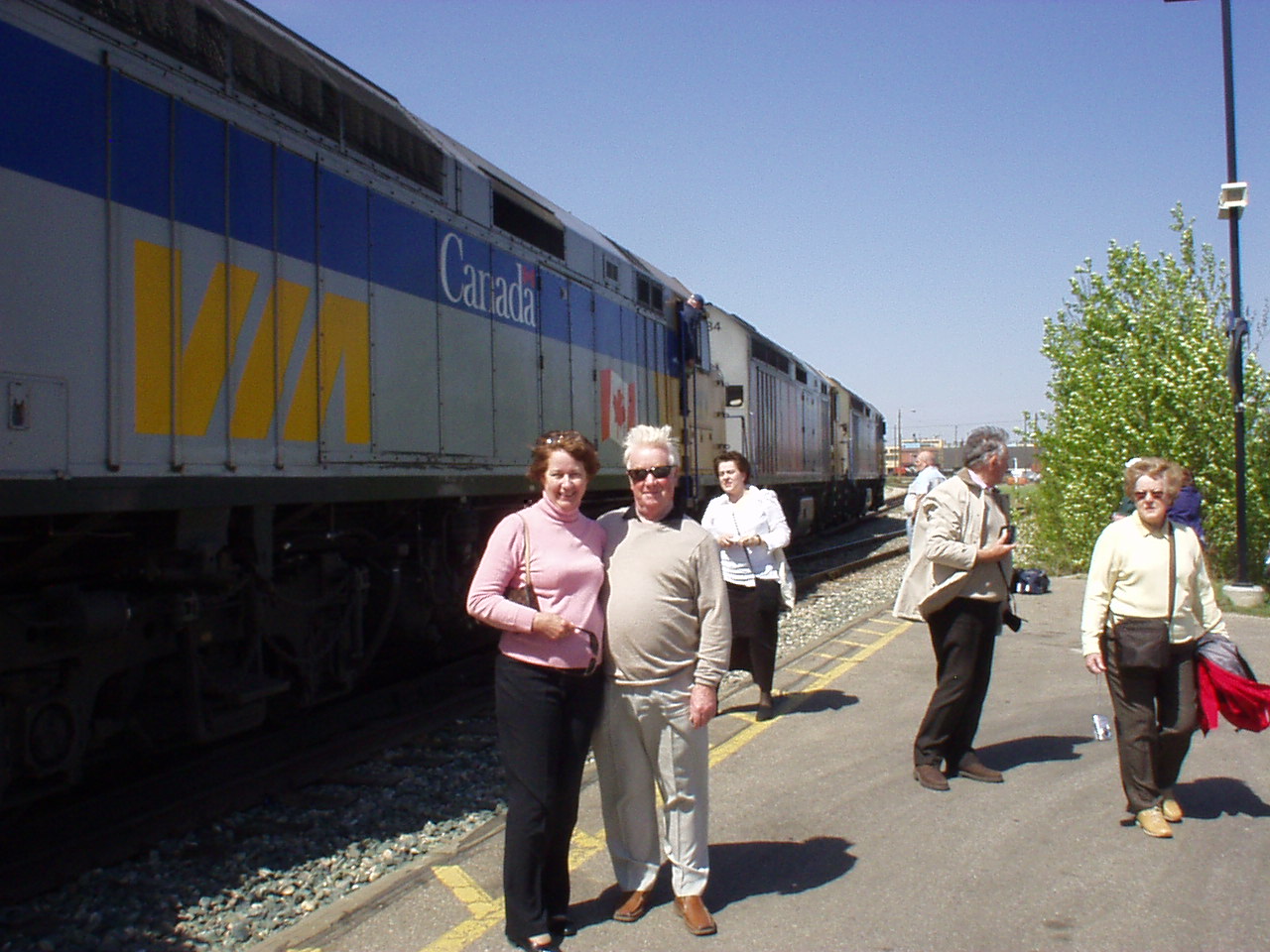
Ann & Michael
This picture has nothing much to do with anything!
Slow week on the census front this week, with nothing much happening. So I have been busy with C-PROP stuff - the new Cornish Parish Registers project. Over a quarter of a million records online and rising.
If anyone wants to drop me a line and tell me your woes or good news - please do so!
Rgds
Michael
Subscribe to:
Posts (Atom)